Sultan Bashiruddin Mahmood
Bashir-ud-Din Mahmood
Sultan Bashir-ud-Din Mehmood
Chaudry Abdul Majid
Chaudry Abdul Majeed
Suleiman Asad
Sulaiman Asad
Muhammed Ali Mukhtar
Muhammad Ali Mukhtar
Mirza Yousaf
Mohammad Tufail
********************
Pakistan Unveils Nuclear Procedures
By Kathy Gannon
Associated Press Writer
Tuesday, July 25, 2000; 7:13 a.m. EDT
ISLAMABAD, Pakistan –– Pakistan has a new procedure for the export
of nuclear material and equipment, according to full-page advertisements
placed by the government in English- and Urdu-language daily
newspapers Tuesday.
The army-led government published application forms for any firm that
might want to export material referred to in the advertisement as "nuclear
substances, radioactive material or any other substances prescribed by the
Pakistan Atomic Energy Commission."
This procedure is apparently part of Pakistan's earlier promise to establish
clear controls over its nuclear material and equipment.
Pakistan and hostile neighbor India declared themselves nuclear powers in
1998 after conducting tit-for-tat nuclear explosions. Both countries say
they possess a nuclear deterrence, but neither has said which nuclear
weapons they possess and how many.
The international community has been pressing both countries to come up
with legislation that will protect the transfer of nuclear technology.
Pakistan has repeatedly given assurances that its nuclear know-how
would not be for sale.
The commerce ministry's public notice also covers the sale of "equipment
used for production, use or application of nuclear energy, including
generation of electricity."
The notice lists the substances that require special permission to sell. The
11 items on that list include enriched uranium, plutonium, heavy water,
nuclear grade graphite, and natural and depleted uranium.
The ministry also has listed 17 pieces of nuclear-related equipment that
requires special permission to export. The list includes nuclear power
reactor, reactor control system, nuclear research reactor, and equipment
for separating uranium isotopes, including gas centrifuges and magnets.
The notice is the first detailed explanation of what Pakistan's military
government considers sensitive materials that require controls. It also gives
responsibility to the Atomic Energy Commission, a government agency, to
verify equipment and material to be exported.
© Copyright 2000 The Associated Press
********************
********************
Pakistan Nuclear Regulatory Authority established
By Our Correspondent
ISLAMABAD, Jan 22: The government on Monday decided to establish a nuclear regulatory authority for regulating
and supervising matters related to nuclear safety and radiation protection measures in Pakistan.
The Pakistan Nuclear Regulatory Authority (PNRA), set up through a presidential ordinance, would be responsible for
planning, developing and executing comprehensive policies and programmes for the protection of life, health and
property against the risk of ionising radiation.
The authority will look after the safety measures of nuclear energy used for peaceful purposes.
The authority, comprising a chairman, two full-time and seven part-time members, all of whom would be appointed by
the federal government, will come into existence within 30 days after the commencement of the ordinance.
Out of the seven part-time members, two would be reputable nuclear scientists or engineers, one, doctor in nuclear
medicine, two nominees each from ministry of health and Pakistan Environmental Protection Agency, a nominee from
Pakistan Atomic Energy Commission and Director General Strategic Plans Division, Joint Staff Headquarters.
The chairman's four-year term will be renewable once. The chairman would be empowered to constitute advisory
committee from amongst its members.
The PNRA, which would also issue licences to installations where radioactivity is generated, would also regulate
equipment used for the production, use or application of nuclear energy for the generation of electricity or any other use.
The authority would be empowered to inspect all nuclear installations, radiation generators, nuclear materials, nuclear
substances or radioactive materials to ensure that regulations concerning safety measures were properly followed and to
cancel or suspend the licence of a person who was found to have contravened any of the provisions of the ordinance.
Under the ordinance, no person would be authorized to discharge, or dispose of radioactive waste without first
obtaining an authorization from the authority.
The authority would also be responsible for ensuring that no nuclear-powered vehicle, vessel or aircraft, or any of these,
carrying nuclear material moves without its permission.
The federal government would issue orders and instructions to the PNRA from time to time it may consider necessary
for carrying out the purposes of the ordinance.
The authority will have the power to issue licenses for the following purposes:
a) acquire, design, manufacture, construct, install, or operate any device that contains any radioactive material or
produce ionizing radiation including consumer products, sealed sources, unsealed sources and radiation generators,
including mobile radiography equipment;
b) establishment, installations and facilities which contain radioactive materials or device or devices which produce
radiation including irradiation facilities, mines and mills processing radioactive ores, installations processing radioactive
substances, nuclear installations and radioactive waste management facilities.
c) explore for mines and mills, extract, acquire, handle, use for medical, industrial, veterinary, or agriculture purposes,
for education, training or research etc, sell, lease, lend, buy, transfer, import, export, convert, enrich, produce, store,
process, reprocess, fabricate, transport, dispose of any radioactive ores, radioactive material, nuclear, substances or
any other substance as the authority may, by notification in the official Gazette, specify; and
d) treat food by ionizing radiation.
© The DAWN Group of Newspapers, 2001
********************
Sunday 3 June 2001
Times of India
US upset over Pak-North Korea
N-missile nexus
Chidanand Rajghatta
WASHINGTON: The United States has publicly
expressed apprehensions about the long-suspected nexus
between Pakistan's nuclear establishment and North
Korea's ballistic missiles program.
Deputy Secretary of State Richard Armitage, who is
expected to drive US policy on South Asia, expressed
the American disquiet over Pakistan's proliferation
activities in a rather cryptic interview with the London
Financial Times on Friday.
Armitage said the US had ''concerns of proliferation with
Pakistan'' and they centered around ''people who were
employed by the nuclear agency and have retired.''
Although Armitage did not mention names or elaborate
on the evidence the US has for the assertion, the finger of
suspicion points to the so-called father of Pakistan's
nuclear bomb and the country's Dr Strangelove, Abdul
Qadeer Khan, who retired recently.
The Pakistan Atomic Energy Commission (PAEC)
chairman Ashfaq Ahmad Khan also retired recently.
Some proliferation experts here feel both the Khans were
compulsorily retired by the military government under
pressure from the US administration. But judging by
Armitage's remarks, Washington's concerns have not
been fully addressed.
US officials say there have been direct contacts between
North Korean officials and "senior figures in the Pakistani
nuclear establishment." There is also evidence that North
Korean officials had recently visited a nuclear weapons
site in Pakistan, FT reported.
The implication is that Pakistan may be funneling nuclear
weapons technology to North Korea in return for North
Koreas ballistic missile technology. This would give
Pakistani missiles a longer range to strike into India, while
North Korea, which is described by the US as a rogue
country, would get the technology to make the bomb.
Coming on the heels of Armitages remarks in New Delhi
last month in which he came close to calling Pakistan a
rogue country, the latest revelations indicate that
Washington's top concerns vis-a-vis Islamabad are
proliferation and terrorism.
In a recent meeting with members of the US Congress,
Armitage suggested that the US needed to take a closer
look at Pakistan-inspired cross border terrorism in
Kashmir, beyond its activities relating to Afghanistan.
Armitage's comments came even as the South Asia
bureau got its new pointperson with the formal swearing
in on Thursday of Christina Rocca as the new Assistant
Secretary of State for the region.
While Rocca will head the South Asia bureau, Armitage,
who succeeded Strobe Talbott in the Deputy Secretary's
post, is widely expected to drive US policy in the region.
Such a development might have caused trepidation in
Indian circles some years back given that Armitage was
closely involved in US covert operations inAfghanistan
with Pakistan's cooperation throughout the 1980s. But
thatconnection also gives him an insight into Pakistan's
programs involving its nuclear establishment and
intelligence agencies.
Evidently, the developments are not to US liking at all.
More recently, therehas also been considerable disquiet
in Washington over the reported move byPakistan to
have China develop a major deep-sea commercial port
of Gwadar inwestern Pakistan. The deal was signed
during the visit of the Chinese leaderZhu Rongji to
Pakistan last week. The new port, located close to the
Gulf ofOman, could give China a foothold in one of the
worlds busiest shipping lanein the Persian Gulf. This and
other issues on the Pakistan front come amid a crucial
policy review of the region by the new administration.
The review, which is currently underway, is widely
expected to endorse astrategic shift according due weight
to India commensurate with itsinstitutional strength,
economic resources and potential, and civil societyamong
other things.
At the same time, US officials are also saying they will
not abandon Pakistanand will do everything to stop it
from sliding into an anarchy-ridden rogue state. All this is
expected to figure during a day-long visit to
Washingtonon June 19 by Pakistan's foreign minister
Abdul Sattar.
********************
Wednesday
20 June 2001
Times of India
US sanctions forcing Pak into
extremism: Sattar
By Chidanand Rajghatta
WASHINGTON: Amid the first
signs of a sympathetic hearing in
Washington to Pakistan's
existential and economic travails,
Foreign Minister Abdul Sattar
made the case here on Monday
that US sanctions against his
country was responsible for the rising tide of extremism
and Islamabad's reliance on nuclear weapons.
In a polished address at the Carnegie Endowment for
International Peace, the patrician foreign minister of the
country that initiated the Kargil war spelt out a new
Pakistani doctrine of "restraint and responsibility" while
making this leap of logic.
"Sanctions have only slowed down the pace of our
economic revival, and prolonged poverty and hardship
which give rise to a host of undesirable trends including
extremism," Sattar said.
"It is not necessary in this forum to mention the risks
inherent in erosion of conventional capability (because of
sanctions) and consequent increase in reliance on
strategic deterrence," he added.
Sattar spin was evidently aimed playing to the fears of a
small but influential section in the administration and
Congress that has been arguing along the same lines.
Several reports in the US media, most recently in the
Philadelphia Inquirer on Monday, suggest the Bush
administration is all set to lift sanctions against India.
Some South Asia hands are arguing that Pakistan should
not be left behind, indicating that Islamabad's gambit of
"save us or we'll destruct" is paying off.
"The more we isolate Pakistan, the more they become a
difficulty... (sanctions on both India and Pakistan should
be removed) really for quite different reasons," the paper
quoted Kansas Senator Sam Brownback as saying.
"We're going to do it together if we can," a White House
official added.
Sattar later met US National Security Advisor
Condoleeza Rice at the White House sans the hoped for
"drop-in" by President Bush.
While conveying that Washington looks forward to a
positive outcome from the Musharraf-Vajpayee summit,
Rice focused primarily on US concern about terrorism,
bigotry, and the Taliban, and Pakistan's policy relating to
these issues.
It was left to Sattar to raise the K-word. He told Rice
that Pakistan expected the Kashmir issue, "the root
cause of tension between the two countries," to be
discussed during the talks. White House officials made
no reference to Kashmir.
From all accounts, the United States now has a much
broader understanding of the root cause of tension
between India and Pakistan and it does not center on
Kashmir alone.
Pakistani officials said Rice and Sattar also discussed
bilateral matters, "in particular, the removal of sanctions".
The foreign minister apprised her of the policy and
priorities of the Musharraf regime, in particular,
economic rival, institutional reforms and good
governance, they added.
Back at the Carnegie center, Sattar offered a broad
defence of Pakistan's nuclear program, arguing that it
was driven by security compulsions of a country that was
traumatised in 1971. He also rubbished India's policy of
no-first use of nuclear weapons, saying "conventional
imbalance has been exploited in South Asia on more
than one occasion in the past."
"The whole purpose of Pakistan's decision to acquire
nuclear capability has been to deter aggression by a
more powerful state (India). To declare that the
capability will not be used is to invite exploitation of
conventional disparity," Sattar told an audience of South
Asia mavens whose reading of history shows Pakistan
aggressively initiated every conventional conflict since
1947.
Instead, Sattar offered what he called a "No first use of
force, nuclear or conventional" policy. He did not
elaborate on whether the "conventional" included New
Delhi's prime concern cross-border infiltration,
insurgency and terrorism.
The Pakistan foreign minister also boasted that his
government has "reinforced custodial controls and
demonstrated in words as well as deeds the policy of
restraint and responsibility," a claim that flies counter to
the Bush administration's knowledge that top Pakistani
nuclear scientists have been in cahoots with North
Korea.
While Sattar has been busy sequencing new logic and
rewriting history, the Bush administration has received
him coolly. White House spokesman Ari Fliescher said
the US is committed to building a mutually beneficial
bilateral relationship with Pakistan, but added that the
"administration is looking forward to a return to a
democracy that will permit fully normalised relations."
Meanwhile, across town, the scene at a conference titled
'New Era in U.S.-India Relations,' organised by FICCI
and the Indian-American Forum for Political Education
presented a stark contrast.
Disclosing that President Bush was planning to visit India
early next year, Torkel Paterson, the White House
pointman for South Asia said "there are many issues on
which two nations share commonality" and there were no
obstacles to prevent the relationship from developing in a
positive fashion.
"We are going to get beyond platitudes... our relationship
has been marked by too much of patronising stuff... we
need to get in to real substance now," Dr Dov Zakheim,
a key Pentagon official who has been a long time insider
of the Bush dispensation said.
Zakheim, who was a member of the close-knit foreign
policy group called the Vulcans' that advised then
Governor George Bush on global issues, recalled several
meetings they had with him. "All of us unanimously felt
his vision had to include India... if we are going to
discuss great powers of the future, then we have to
discuss India," he said.
That evidently now constitutes official policy. While
reporting that the Bush administration has decided to lift
sanctions on India to clear ways for expanded military
and economic ties, the Philadelphia Inquirer quoted an
unnamed White House official as saying, "We want to
include India in a strategic calculus."
********************
Pakistani Nuke Scientists Questioned
By Munir Ahmad
Associated Press Writer
Thursday, Oct. 25, 2001; 5:31 p.m. EDT
ISLAMABAD, Pakistan –– Pakistani authorities interrogated two leading
nuclear scientists Thursday about possible contacts with the leader of
Afghanistan's Taliban militia, government officials said.
Sultan Bashiru-Din Mehmood, one of the founders of Pakistan's nuclear
program, was detained Tuesday by intelligence agents in the eastern city
of Lahore. Abdul Majid, a scientist who worked for years with Mehmood
at the Pakistan Atomic Energy Commission, also was also being held,
officials in the Interior Ministry said on condition of anonymity.
Government officials were not available to confirm the detentions on the
record.
The sources said the men were being questioned about any possible links
to Afghan officials, including Taliban leader Mullah Mohammed Omar.
Neither has been charged with any crime.
Mehmood and a group of friends who are mostly scientists and engineers
have been working on rehabilitation projects in war-ravaged Afghanistan.
But a senior government official said on condition of anonymity that
Mehmood is not suspected of being linked to terrorism suspect Osama
bin Laden or his al-Qaida network.
Foreign nations worry about political unrest in Pakistan because the
country, like its neighbor and rival, India, is a nuclear power. Some say
uncertainty in the government could threaten the security of Pakistan's
nuclear arsenal.
President Gen. Pervez Musharraf has drawn the wrath of Islamic militants
for his decision to support the United States in its fight against terrorism
and its airstrikes on Afghanistan. Some have advocated the overthrow of
Musharraf.
But the president insists that the nation is behind him, and that Pakistan's
nuclear weapons are in secure hands.
© Copyright 2001 The Associated Press
********************
Aid Efforts Face Setbacks in Afghanistan
As Winter Approaches, Lootings, Bombs, and the Taliban Hinder Relief Efforts
By Rajiv Chandrasekaran
Washington Post Foreign Service
Friday, October 26, 2001; 3:46 PM
ISLAMABAD, Pakistan, Oct. 26 – Efforts to provide food and emergency supplies to millions of Afghans before the onset of winter were set back today
by the looting of U.N. aid stockpiles, the reported bombing of a Red Cross compound by U.S. warplanes for the second time in 10 days and the
commandeering of relief-agency equipment by the country's ruling Taliban militia.
The U.N. refugee agency said its warehouse in the southern Afghan city of Kandahar, which contained tents, tarps and thousands of items of clothing, had
been plundered. The International Committee of the Red Cross said that U.S. bombs hit its compound in Kabul, setting alight three warehouses that held
food, tents and other emergency supplies. And the World Food Program said that Taliban soldiers confiscated radios used to coordinate food distribution
from U.N. offices in three cities.
The Red Cross compound in Kabul was hit for the first time on Oct. 16. Red Cross officials said their facility had a large red cross on the roof. They said
they have provided the locations of their warehouses to the U.S. military.
"We are appalled by what happened," said Red Cross spokesman Mario Musa. "The compound is clearly marked."
At the Pentagon, Rear Adm. John Stufflebeem, the director of operations for the Joint Chiefs of Staff, said he could not confirm that the compound had
been struck.
The Taliban reportedly parked vehicles near the compound, apparently trying to use it as a shield.
The reported bombing of the compound has prompted new concerns about targeting errors by U.S. warplanes. Earlier this week, the United Nations
accused the United States of bombing a hospital in a military compound near the western city of Herat. The U.N. also said a cluster bomb was dropped on
a nearby village, killing nine people.
The Taliban have accused the United States of killing more than 1,000 civilians, a claim U.S. officials have dismissed as an exaggeration. On Thursday, the
Taliban said U.S. planes bombed a crowded passenger bus near Kandahar and people leaving a mosque near Herat.
Today, the Taliban appealed to the United Nations for assistance in clearing unexploded bombs dropped since the airstrikes began Oct. 7. But even as
they asked for help, Taliban soldiers continued confiscating U.N. equipment. In Kandahar, vehicles belonging to the U.N. refugee agency and the World
Food Program had been taken, U.N. officials said.
The Red Cross said its Kabul warehouses also served as a distribution center for a program to feed up to 8,000 families of disabled people.
Tens of thousands of families in Kabul are dependent on food aid. A U.N. program to distribute grain was halted earlier in the week because of security
worries, but a World Food Program spokesman said the handouts resumed today.
After three years of drought and civil strife that interfered with crop-planting, more than 6 million Afghans are facing a severe food crisis, according to
humanitarian officials. The U.N. Food and Agriculture Organization warned on Thursday that Afghanistan could face "mass starvation" conditions this
winter if enough food is not trucked or airlifted into hard-hit areas in the country's mountainous north before heavy snows make roads impassable.
Although aid officials said at least 50,000 tons of food need to be distributed each month across Afghanistan, a WFP spokesman said only 23,000 tons
have been handed out since food shipments into the country resumed last month. Aid workers said getting food shipments into Afghanistan from
neighboring countries has not been a significant problem, but they said that fuel shortages, looting and fears of military strikes have interfered with plans to
distribute food to towns and villages.
"The deteriorating security conditions are seriously impeding our efforts," said WFP spokesman Francesco Luna.
To reduce the risk of looting, the WFP has decided to ship food directly to needy areas, where international aid organizations will distribute it. But one
large aid group, Oxfam International, expressed frustration at the slow pace of food shipments. An Oxfam spokesman said the group had run out of food
to hand out in several areas.
"People are going hungry in their villages," said the spokesman, Sam Barratt. "But since they're not in refugee camps, they're invisible to the outside world."
Separately, the Pakistani government said today that it was questioning two prominent nuclear scientists about their ties to the Taliban, particularly the
movement's leader, Mohammad Omar. But a government spokesman said the two had not been charged and likely would be released from custody within
a few days.
The scientists were identified as Sultan Bashiru-Din Mehmood, a pioneer member of Pakistan's nuclear program, and Abdul Majid, who worked with
Mehmood for years at the Pakistan Atomic Energy Commission.
Mehmood, who is retired, had been working on rehabilitation projects in war-ravaged Afghanistan.
Foreign Ministry spokesman Riaz Mohammed Khan said the two were not suspected of passing nuclear secrets to Afghanistan. "There is neither suspicion,
nor was the situation related to that," Khan said. He said the investigation related to a broader examination "into the credentials" of aid organizations that
worked inside Afghanistan.
Khan insisted that Pakistan's nuclear weapons and technology were secure. "Pakistan's nuclear materials are under multi-layered custodial controls," he
said. "We will not transfer materials which are of a sensitive nature, including nuclear materials, to any country."
A Pakistani newspaper reported today that a person believed to be a microbiology student from Yemen who had been studying at Karachi University was
handed over to U.S. authorities, who spirited him out of the country on a small jet early this morning. A Pakistani government source said the student, Jamil
Qasim Saeed Mohammed, was wanted in connection with a criminal investigation in the United States.
Khan and other Pakistani officials said they were unaware of the handover.
In Karachi, Pakistan's commercial capital, an estimated 40,000 people took part in a protest today against the U.S. airstrikes and Pakistani President
Pervez Musharraf's decision to support the U.S.-led anti-terrorism campaign.
In the city of Peshawar, near the Afghan border, an influential Muslim cleric claimed that thousands of people were gathering at his religious school to
volunteer to join a holy war against the United States.
Special correspondent Kamran Khan in Karachi contributed to this report.
© 2001 The Washington Post Company
********************
Friday October 26 12:20 PM ET
Pakistan Scoffs at Bin Laden Nuclear Link
ISLAMABAD (Reuters) - Pakistan dismissed as absurd British media
reports on Friday that Osama bin Laden (news - web sites), the
suspected mastermind of the bloody September 11 attacks on the
United States, had obtained nuclear material from Islamabad.
The Times newspaper and Channel Four television quoted Western
intelligence sources as saying the Saudi-born dissident had obtained the
material illegally from Pakistan, a nuclear capable country.
They said there was concern he could try to release radioactive material
through a non-explosive "dirty bomb."
A Pakistani Foreign Ministry spokesman said the allegation was absurd.
"Our nuclear materials are in very safe hands, these are absurd
allegations," spokesman Riaz Mohammad Khan told Reuters.
Pre-empting further speculation, Khan also denied that two retired
nuclear scientists, currently in "protective custody," had been arrested
on suspicion of giving out nuclear information.
"Absolutely not," he said.
Bashiruddin Mahmood and another colleague were recently picked up
by the intelligence services. Khan said they had been questioned in
relation to a non governmental organization they ran that worked in
Afghanistan (news - web sites) and had not been arrested.
RANGE OF WEAPONS
The Times and Channel Four said that bin Laden and his al Qaeda
network of Islamic extremists, which operates out of neighboring
Afghanistan, did not have the technology to make a nuclear bomb.
Citing an "informed source," the Times said bin Laden appeared to
have amassed a "terrifying" range of weapons, although the source said
a nuclear attack was still beyond him.
Bin Laden could also be behind the spate of anthrax outbreaks terrifying
the American public, although the FBI (news - web sites) has yet to
produce any conclusive links.
Both President Bush (news - web sites) and British Prime Minister Tony
Blair (news - web sites) have given regular warnings that bin Laden
would wreak even greater destruction if he could.
However, Blair's Downing Street office urged the public not to be
unduly worried by the reports.
"We believe that bin Laden and his al Qaeda network would if they
could develop a nuclear capability, but people should treat with extreme
skepticism any reports that he has such a capability," a spokesman told
Reuters.
Independent experts said it was unlikely bin Laden could have
developed a nuclear capability.
"The barriers to being able to gain nuclear or even radiological
capability are very high," said John Gearson, senior lecturer in defense
studies at King's College in London.
"The talk of nuclear, biological and chemical terrorism is a classic
scenario of us terrorizing ourselves. The fear of these threats is greater
than the fear of what we know they can do," Gearson added.
********************
Pakistan Questioning Two Nuclear Scientists
By Rajiv Chandrasekaran
Washington Post Foreign Service
Saturday, October 27, 2001; Page A20
ISLAMABAD, Pakistan, Oct. 26 -- The Pakistani government said today it is questioning two prominent nuclear scientists about their ties to the Taliban,
particularly the movement's leader, Mohammad Omar. But a government spokesman said the two were not suspected of passing nuclear secrets and likely
would be released from custody within a few days.
The scientists were identified as Sultan Bashiru-Din Mehmood, a pioneer member of Pakistan's nuclear program, and Abdul Majid, who worked with
Mehmood for years at the Pakistan Atomic Energy Commission.
Mehmood, who is retired, had been working on rehabilitation projects in war-ravaged Afghanistan.
Foreign Ministry spokesman Riaz Mohammed Khan said the government's interest in the two was not related to its nuclear program, which detonated a
nuclear device in 1998. "There is neither suspicion, nor was the situation related to that," Khan said. He said the investigation related to a broader
examination "into the credentials" of aid organizations that worked inside Afghanistan.
Khan said Pakistan's nuclear weapons and technology were secure. "Pakistan's nuclear materials are under multilayered custodial controls," he said. "We
will not transfer materials which are of a sensitive nature, including nuclear materials, to any country."
A Pakistani newspaper reported today that a person believed to be a microbiology student from Yemen who had been studying at Karachi University was
handed over to U.S. authorities, who spirited him out of the country on a small jet early this morning. A Pakistani government source said the student, Jamil
Qasim Saeed Mohammed, was wanted in connection with a criminal investigation in the United States.
In Karachi, the country's commercial capital, an estimated 40,000 people took part in a protest today against the U.S. airstrikes and Pakistani President
Pervez Musharraf's decision to support the U.S.-led campaign against terrorism.
In Peshawar, near the Afghan border, an influential Muslim cleric said thousands of people were gathering at his religious school to volunteer to join a holy
war against the United States.
Special correspondent Kamran Khan in Karachi contributed to this report.
© 2001 The Washington Post Company
********************
October 28, 2001
RESPONSE TO TERROR
Pakistan Hands Over Man in Terror Probe
Asia: Yemeni believed to be a microbiology student in Karachi is deported to the United States in secrecy,
military sources say.
By ALISSA RUBIN, TIMES STAFF WRITER
ISLAMABAD, Pakistan -- An Arab man believed to be a student of
microbiology at Karachi University was detained by Pakistani authorities
and handed over to the United States last week under highly secretive
circumstances, Pakistani military sources said Saturday.
The man, who authorities confirmed was named Jamil Qasim Saeed
Mohammed, was detained and deported to the U.S. in connection with
America's terrorism investigation.
"This is not unusual. Over the last six months, many people have been
deported if they had false documents or suspect links with terrorist
organizations in African and Middle Eastern countries," a military
intelligence source said. Terrorist organizations in Africa are suspected
of being connected to the bombing of the U.S. embassies in Nairobi and
Kenya and perhaps the bombing of the U.S. guided missile destroyer
Cole in Yemen. Osama Bin Laden's Al Qaeda organization is suspected
of carrying out the embassy bombings.
The military sources added that there would be a broad effort in the coming weeks to extradite or
expel all illegal foreigners from Pakistan who had traveled to countries where terrorist organizations
are known to be operating. "While the list of these people runs into the hundreds, whoever is caught
will be expelled," the military intelligence source said.
Mohammed was handed over to the United States under cover of night. The transfer took place
about 1 a.m. Tuesday and involved masked U.S. officers, according to witnesses at the Karachi
airport.
The plane was parked in a dark and isolated area of the terminal, according to witnesses, and
military sources confirmed that special arrangements were made for the man's deportation.
The plane arrived from Amman, Jordan, and headed back there after picking up the detainee. A
private company was used to service the U.S. aircraft rather than national airport authorities.
The deportation was one of two. The other was of a Jordanian, Zaid Safarani, believed to be on a
U.S. watch list. It was not clear if he was deported at the same time as Mohammed.
The Yemeni man is one of three scientists recently reported to have been detained. The other two
are retired nuclear scientists, Bashiruddin Mehmood and Abdul Majeed. Mehmood has had a
distinguished scientific career in Pakistan's nuclear program.
The deported man was a student of Yemeni origin who went to Karachi in 1993 and was a student
there, according to local reporters. Karachi is a large city on the Arabian sea in southern Pakistan.
He stopped showing up for classes in early October. Shortly before he disappeared, the Interior
Ministry requested all information about him from the university.
Copyright 2001 Los Angeles Times
********************
Tuesday October 30 8:57 AM ET
Pakistan Questions Scientist with Afghan
Links
By Tahir Ikram
ISLAMABAD (Reuters) - A former Pakistani nuclear scientist who quit
government service to work for a food aid group in Afghanistan (news -
web sites) was being held for questioning but was not under arrest,
Islamabad's top spokesman said on Tuesday.
Bashiruddin Mahmood's family have expressed concern because they
have not spoken to him since Saturday, and his son said he understood
he was in the "protective custody" of the government.
Major General Rashid Qureshi, spokesman for President Pervez
Musharraf, told a news conference that Mahmood was involved in a
non governmental organization (NGO) and had gone to Afghanistan.
"There are certain questions that we need to ask him," he said, without
specifying which government agency was holding the well-known
nuclear scientist. He said Mahmood was not involved with Pakistan's
nuclear weapons program.
"He is not under arrest," Qureshi said, adding Mahmood was not well
and was believed to be in hospital.
Qureshi offered no further details but Mahmood's son, Asim, told
Reuters he had a heart condition.
"He has not come home yet... we are worried about his health," Asim
said, adding the authorities had not explained the reasons for the
detention.
In 1998, Mahmood wrote newspaper articles protesting then-prime
minister Nawaz Sharif's intention to sign the nuclear Comprehensive
Test Ban Treaty. Islamabad has not signed the agreement.
Soon afterwards, Mahmood took early retirement from the Pakistan
Atomic Energy Commission and devoted his time to welfare work,
particularly for Afghans suffering from 20 years of war and the worst
drought in living memory.
Another former nuclear scientist, identified only as Majeed and a
colleague of Mahmood, had also been in custody since October 23,
Asim said.
The Dawn newspaper said Mahmood was released on Monday but
Asim said he had not come home or spoken to the family since
Saturday, although Majeed had called his home last night and appeared
to be "shaken."
NO LINKS TO WEAPONS
Qureshi said neither man was involved with Pakistan's weapons-linked
nuclear program. Mahmood had headed a nuclear power reactor in the
Khushab area of central Punjab province.
Pakistan's Foreign Ministry spokesman last week dismissed any
suggestion that the scientists were being detained in a nuclear-related
investigation, and said Mahmood's NGO was under investigation as
were all NGOs working in Afghanistan.
Pakistan unveiled its atomic capability by carrying out nuclear tests in
May 1998 in response to tests by rival India.
The government says Pakistan's nuclear program is in secure hands and
has also assured the world that it will not export sensitive technology
abroad.
Local media reported the investigation also involves other associates of
Mahmood assisting him in the relief work through an Islamabad-based
NGO.
Asim said his father set up the NGO to send food and aid to
Afghanistan, including five trucks of medicines after the start of U.S.-led
strikes against the Taliban over their refusal to surrender Osama bin
Laden (news - web sites), chief suspect in the September 11 attacks on
America.
Asim said his father was also setting up a flour mill in the southern
Afghan city of Kandahar to help overcome food shortages and it was
being tested just before the air strikes began.
********************
America At War: Dispatches
Compiled from Wire and Staff reports
Tuesday, October 30, 2001; 2:44 PM
U.S. May Remove Six States from Visa Waiver List
WASHINGTON, 2:34 p.m. EST - U.S. authorities are considering removing six states from a list of 29 whose citizens can enter the United States for 90
days without a visa, State Department spokesman Richard Boucher said Tuesday.
Boucher told a news briefing that Argentina, Belgium, Italy, Portugal, Slovenia and Uruguay were under review.
Mineta Vows to Increase Airport Security
WASHINGTON, 1:34 p.m. EST - Acknowledging an "unacceptable" level of problems at airport security checkpoints, Transportation Secretary Norman
Y. Mineta said Tuesday that government agents would make sure passengers and luggage were properly screened.
Mineta said that special agents from the Federal Aviation Administration and other Transportation Department agencies would inspect the screening. He
also asked the FAA to look at hiring more agents.
Musharraf Won't Press Bush on Halt to Bombing
ISLAMABAD, Pakistan, 1:24 p.m. EST - Pakistani President Pervez Musharraf said Tuesday he detected splits among Taliban supporters in Afghanistan
that could open the way for a political end to the conflict.
“I do see that. Afghanistan has suffered, the people are suffering so much that I am reasonably sure there are many people who even question the wisdom
of their suffering for the sake of somebody who is there and not an Afghan, like Osama bin Laden and his people,” he said.
However, Musharraf said he accepted that the military campaign had to continue in Afghanistan and he would not press President Bush at their meeting
next month to halt bombing during the Muslim fasting month of Ramadan that begins about Nov. 17.
Daschle Sees Hart Building Reopening Mid-November
WASHINGTON, 12:51 p.m. EST— Officials have decided to pump chlorine dioxide gas into the shuttered Hart Senate Office Building to rid it of
potentially deadly anthrax spores, Senate Majority Leader Tom Daschle said Tuesday.
Pending a final approval by scientists who are studying the plan, Daschle said the process should allow the building to reopen around mid-November. Half
the Senate’s 100 members have their offices in the building, which has been closed since Oct. 17, two days after Daschle’s office received an
anthrax-laden letter.
U.N. Blasts Conditions at Taliban-Run Refugee Camp
QUETTA, Pakistan, 12:16 p.m. EST - Malnutrition and dysentery are sweeping through a Taliban-run refugee camp on the Afghan side of the Pakistani
border and many families are living in the open without shelter, the United Nations said Tuesday.
The U.N. High Commisioner for Refugees urged Afghanistan’s fundamentalist Islamic movement to allow people fleeing the U.S. bombing and three years
of severe drought to cross to Pakistan where they can be cared for.
“The situation in Spin Boldak, the border post on the Afghan side of the border, is deteriorating rapidly,” UNHCR spokesman Yusuf Hassan told reporters
in Quetta, the capital of Pakistan’s western province of Baluchistan.
95 U.S. Warplanes Pound Afghanistan Today
WASHINGTON, 11:49 a.m. EST - Nearly 100 U.S. warplanes pounded Taliban and al Qaeda targets in Afghanistan Tuesday as the American and
British defense chiefs met at the Pentagon to discuss the increasingly controversial air campaign.
Pentagon spokeswoman Victoria Clarke told reporters that 95 air strikes were being carried out, especially against Taliban troops protecting Kabul and
Mazar-i-Sharif, on the 24th day of nonstop raids sparked by the Sept. 11 attacks on America.
Blair Bolsters U.S. War Effort
CARDIFF, Wales, 9:45 a.m. EST—Britain's Tony Blair tried to retake the moral high ground Tuesday in the West's war with Osama bin Laden, offering
an emotional tribute to the victims of last month's suicide attacks and vowing not to falter.
Against a backdrop of slipping public support for the war in Britain, Blair urged the country to remember the Sept. 11 attacks, which killed "in cold blood"
as many as 4,800 people in New York and Washington.
The prime minister's emotional appeal sought to tackle growing criticism of the U.S.-led campaign against bin Laden after a series of bombing blunders and
tactical setbacks.
"It is important we never forget why we are doing this, never forget how we felt watching the planes flying into the Trade Towers," Blair told the Welsh
parliament in Cardiff.
Top Iranian Cleric Bars U.S. Talks
TEHRAN, 8:42 a.m. EST—Iran's supreme leader Ayatollah Ali Khamenei rejected any direct talks with the United States on Tuesday and threatened to
sack officials who speak in favour of U.S. ties.
"This is not a prejudiced opinion. It is an educated assessment based on thorough studies and experiences of other countries," Khamenei said in a public
speech in the central city of Isfahan.
"We have reached the conclusion that not just relations, but any negotiation, with America is against the nation's interests," he said in remarks broadcast on
state television.
Some Iranian reformers have demanded that Iran seize the chance arising from the September 11 suicide attacks in the United States and move to end 23
years of estrangement.
14 Killed in Kashmir
SRINIGAR, 8:37 a.m. EST—Fourteen people were killed in gunbattles in Indian Kashmir, where separatist violence has escalated since the start of
U.S.-led strikes on Afghanistan, police said on Tuesday.
Indian security forces shot dead five Islamic militants on Tuesday near the Pakistan border in Poonch district southwest of Srinagar, the Muslim-majority
state's summer capital.
The head of a United Nations military observer group monitoring the disputed border in Kashmir said on Monday said he expected tensions to rise in the
region.
"My assessment is that the situation will become more tense in the time coming, not only along the LoC but also in whole of Jammu and Kashmir state,"
said Major General Hermann Liodolt, head of the U.N. military observer group monitoring the region.
Pakistan Questions Nuclear Scientist
ISLAMABAD, 8:26 a.m. EST—A former Pakistani nuclear scientist who quit government service to work for a food aid group in Afghanistan was being
held for questioning but was not under arrest, Islamabad's top spokesman said on Tuesday.
The family of Bashiruddin Mahmood, an outspoken defender of the country's nuclear weapons program, have expressed concern because they have not
spoken to him since Saturday. His son said he understood he was in the "protective custody" of the government.
"There are certain questions that we need to ask him," a spokesman for President Pervez Musharraf told a news conference, without specifying which
government agency was holding the well-known nuclear scientist.
Saddam Hussein Calls for U.S. Defeat
BAGHDAD 8:14 a.m. EST—President Saddam Hussein of Iraq urged the world on Tuesday to prevent the United States winning its war in Afghanistan
and said Washington should get rid of its weapons of mass destruction before any other country.
"The world now needs to abort the aggressive U.S. schemes, including its aggression on the Afghan people, which must stop. It must not allow the U.S. to
be victorious," Saddam said.
He made the statement in an open letter to the West, his third since the September 11 attacks on New York's World Trade Centre and the Pentagon near
Washington.
U.N. Envoy, Musharraf Agree on Afghan Rule
ISLAMABAD, 6:50 a.m. EST—The United Nations agreed with Pakistan on Tuesday that any future Afghan government must not allow its territory to
become a base for hostile groups.
U.N. special envoy for Afghanistan Lakhdar Brahimi met Pakistani military ruler General Pervez Musharraf for an hour for what U.N. spokesman Eric Falt
termed an "in-depth discussion" on the conflict in Afghanistan.
Brahimi and Musharraf agreed a settlement in Afghanistan would have to guarantee its territorial integrity and any government would have to be devised by
Afghans and reflect all groups in the diverse land, Falt said.
© 2001 Washington Post Newsweek Interactive
********************
Pakistani Nuke Scientist in Hospital
By Munir Ahmad
Associated Press Writer
Wednesday, Oct. 31, 2001; 6:39 a.m. EST
ISLAMABAD, Pakistan –– A Pakistani nuclear scientist detained for
questioning last week about his links with Afghanistan's Taliban has been
hospitalized after complaining of chest pain during interrogations, his family
said Wednesday.
Sultan Bashir-ud-Din Mehmood was admitted to the Armed Forces
Institute of Cardiology on Tuesday, according to his son, Asim Mehmood,
who is a doctor. Government officials confirmed the scientist was being
treated.
Mehmood, who was first detained last week, was briefly released and
taken into custody again this week. Six of his colleagues, including one
other scientist, remained in custody Wednesday, government sources said.
U.S. intelligence officials have also interrogated Mehmood and his friends,
according to a source at Pakistan's Inter-Services Intelligence, or ISI. The
source spoke on condition of anonymity
All those detained are members of a non-governmental organization, run
by Mehmood, that works on development projects to help rehabilitate
Afghanistan and stimulate its economy. The organization had operated
inside Afghanistan with the backing of Taliban leader Mullah Mohammed
Omar.
Mehmood, one of Pakistan's top nuclear scientists, played a crucial role in
helping the nation become a nuclear power in the 1990s.
The international community is particularly concerned about Pakistan's
nuclear weapons in recent weeks, given recent militant unrest related to
the government's support of U.S. attacks on Afghanistan.
President Gen. Pervez Musharraf has repeatedly insisted that the country's
nuclear arsenal is safe. Officials also have said they do not suspect
Mehmood of leaking any nuclear information to the Taliban.
© Copyright 2001 The Associated Press
********************
Pakistan Releases 2 Nuke Scientists
The Associated Press
Saturday, November 3, 2001; 9:14 AM
ISLAMABAD, Pakistan –– Authorities have released two Pakistani nuclear scientists who were detained Oct. 23 for questioning about their links with
Afghanistan's ruling Taliban movement.
Sultan Bashir-ud-Din Mehmood and Abdul Majid were released this week and were at their homes in Islamabad, Maj. Gen. Rashid Quereshi said at a news
conference Friday. Relatives of both men said their movements were restricted.
Quereshi said the scientists were not involved in any weapons programs and that they were questioned about aid projects they run in Afghanistan.
Mehmood, who played a key role in developing Pakistan's nuclear program, is head of a non-governmental organization that is trying to help rehabilitate
Afghanistan and stimulate its economy.
Mehmood's aid organization, Tameer-e-Ummah, had operated inside Afghanistan with the backing of the Taliban's leader, Mullah Mohammed Omar.
A spokesman for the organization said five members remain in custody.
The international community is concerned about the security of Pakistan's nuclear weapons because of fears that some elements in the military remain
sympathetic to the Taliban, which is under daily attack from U.S. air power.
President Gen. Pervez Musharraf has repeatedly insisted that Pakistan's nuclear arsenal is safe, and Pakistani officials have said they do not suspect any
nuclear information has been given to the Taliban.
Mehmood, who left the Pakistan Atomic Energy Commission in 1998, was hospitalized a few days ago after complaining of chest pains during his
interrogation, his family said.
"We are happy that our father is among us and we are thankful to the government for releasing him," said Dr. Asim Mehmood, the scientist's son.
© 2001 The Associated Press
********************
November 12, 2001
RESPONSE TO TERROR
Pakistan Nuclear Expert Recalls Detention
Probe: Specialist was held with six others on suspicion of leaking secrets through a foundation that sought to
aid the Taliban in rebuilding Afghanistan.
By RONE TEMPEST, TIMES STAFF WRITER
ISLAMABAD, Pakistan -- Abdul Majeed apologized for not inviting
his foreign visitor inside.
Standing at the front gate of his modest bungalow here Sunday as a
brood of chickens pecked nearby for food, the retired nuclear engineer
said his activities have been restricted since Americans started
interrogating him.
"They thought we were making a nuclear bomb for Afghanistan,"
Majeed said. The 62-year-old specialist in nuclear fuels was one of
seven Pakistanis detained by intelligence authorities in late October in
connection with a welfare organization they operated inside Afghanistan.
Majeed and a prominent nuclear scientist, Bashiruddin Mehmood, were
released to their homes after 10 days but remain under supervision. The
five other detainees--businessmen and retired military officers who are
all board members of the Ummah Tameer-e-Nau, or Reconstruction
Foundation, founded by Mehmood--are still in custody.
The men were interrogated in several four- to five-hour sessions by
American and Pakistani authorities, Majeed said. "They told us they had
been sent by President Bush and [Pakistani] President [Pervez]
Musharraf," he said. U.S. diplomats here had no comment on his
statement.
Coming in the wake of the Sept. 11 attacks, the activities of Majeed and
Mehmood, two high-ranking former employees of Pakistan's Atomic
Energy Commission, raised concerns that the country's nuclear secrets
might have been compromised. The contention has been repeatedly and
forcefully denied by the Pakistani government.
But the fears were rekindled last week after a Pakistani journalist
reported that Afghanistan-based militant Osama bin Laden told him that
his Al Qaeda organization possesses nuclear arms "as a deterrent."
A report in a Pakistani newspaper Sunday quoted an unidentified
Pakistani official who said Mehmood met with Bin Laden on two
occasions before Sept. 11. Mehmood, who once supervised
construction of nuclear power reactors, could not be reached for
comment.
But Majeed, in his first interview with a foreign journalist since his
detention, insisted that the activities of the Ummah Tameer-e-Nau
organization were entirely benign, concerned only with helping the
Taliban regime rebuild Afghanistan's infrastructure after two decades of
war. Majeed said he had never met Bin Laden or Taliban leader Mullah
Mohammed Omar.
Pakistan joined the nuclear weapons club with an underground test in
1998 and is now believed to have acquired material for 30 to 40
warheads.
Pakistani intelligence sources say that although fears about leaks of
nuclear secrets appear to have subsided, the investigation is ongoing,
under strict secrecy. "It is a very sensitive issue. This is evident from the
fact that we still are not done with the investigation," an intelligence
source said.
The seven men were taken into custody Oct. 23, but several days passed before family members
received any phone calls from them.
"My father had a meeting in our office; people were waiting for him," said Shahzad Baig, the eldest
son of one of the men detained, Mirza Yousaf Baig, 60, a construction company owner in Lahore.
"He is a punctual man. After he failed to show up, we filed a missing person report. We didn't
receive a phone call from him in three days."
Mirza Baig remains in custody, along with another industrialist and three retired military officers.
They reportedly are being questioned about the source of money that went into the group, which
has been linked to the Al Rashid Trust, a charity on the U.S. terrorist watch list.
"To this day," Shahzad Baig said more than two weeks after his father's detention, "no one in the
government has told us anything about what he is being held for or when he will be released."
The fact that Mirza Baig and others involved in selling stock and raising money for the organization
are still in custody indicates that the investigation has shifted from the leakage of nuclear secrets to
the funneling of money into the Taliban regime.
Mehmood's relatives said they initially feared that the two former nuclear specialists would be
"extradited to the United States and that we would never see them again."
As the group's founder and a vocal advocate of the Pakistani nuclear weapons program, Mehmood
appears to be central to the investigation. The 55-year-old senior director of the nuclear program
resigned in protest in 1998 after then-Pakistani Prime Minister Nawaz Sharif agreed to sign the
international Nuclear Nonproliferation Treaty.
The Pakistani government has denied any direct link between Mehmood and the nuclear weapons
program. However, on March 23, 1999, Mehmood was presented a service award with a citation
that said: "Despite [U.S.] sanctions against the transfer of nuclear technology to Pakistan, Mehmood
was able to achieve his important and critical tasks."
Before his detention, Mehmood was highly critical of the U.S. bombing campaign in neighboring
Afghanistan. He described the Taliban regime as "the ideal Islamic state."
After the Ummah Tameer-e-Nau organization was created in 2000, it built a flour mill in Kandahar,
the Taliban spiritual capital in Afghanistan, and purchased land in the Kandahar region on which it
planned to develop agriculture. Business cards from the organization carry the motto "Build to Help,
Help to Build" and list addresses at Mehmood's home in Islamabad and in Kabul, the Pakistani and
Afghan capitals.
Majeed said he accompanied Mehmood on four trips to the Afghan cities of Khost, Kandahar,
Kabul and Jalalabad beginning in October 2000. He said they visited water projects, academic
institutions and mineral fields that the Taliban regime said it needed help developing.
On their last trip, in August, Majeed said, they met with Haji Abdul Kabir, Taliban deputy prime
minister, to discuss reviving a hydroelectric project on the Kabul River that had been abandoned by
the Swiss government after the Taliban took control of most of the country in 1996.
Majeed said none of the foundation's activities touched on nuclear weaponry.
"I have only limited, general knowledge of these things, only what you can read in journals," he said.
He said his participation was born out of sympathy for the Afghan people, whom he felt had been
abandoned by Western donors after the Cold War ended.
"I had just retired," Majeed said, explaining how he got involved in the Ummah Tameer-e-Nau
organization. "I was free, so I thought we should go do something for humanity."
The interview ended abruptly after a man in a leather jacket carrying a briefcase came up and asked
Majeed questions in the Urdu language.
The Taliban scoffs at the idea that the men were involved in developing a nuclear weapons program
for Afghanistan.
"A country that does not have the facilities to manufacture glass must not be expected to have
sophisticated items like nuclear weapons," said Taliban Ambassador to Pakistan Abdul Salam
Zaeef.
For information about reprinting this article, go to http://www.lats.com/rights/register.htm
Copyright 2001 Los Angeles Times
********************
December 1, 2001
Germ Weapon Plans Found at a Scientist's House in Kabul
By DAVID ROHDE
ABUL, Afghanistan, Nov. 30
A group of armed men, reportedly Americans, dressed in gas masks, rubber gloves and boots, removed powdered chemicals this week from the home of a retired Pakistani nuclear scientist here, Afghan security guards at the house said today.
The guards, posted by the Northern Alliance, said the men had warned them to stay away from the house because the chemicals could be dangerous.
Diagrams and documents found there suggest that the scientist, Sultan Bashiruddin Mahmood, may have been working on a plan to drop cyanide or anthrax spores from high- altitude balloons. Copies of American military documents found there described anthrax vaccines and how the spores could be used as a weapon.
Mr. Mahmood and another Pakistani scientist, Chaudry Abdul Majeed, are under detention in Pakistan in connection with the discoveries in Kabul. Mr. Mahmood's family has insisted that he is innocent.
A workroom that had been littered with papers was empty today and appeared to have been swept or vacuumed.
Mahmad Ajan, a security official from the Northern Alliance who is guarding the house, said four men he believed were Americans had cleaned out the house three days ago.
"They had masks and they had rubber gloves and boots," he said. "They spoke English and had pistols."
Pentagon officials have said unspecified Americans have removed chemicals from 40 suspected Al Qaeda sites in Afghanistan for testing.
Mr. Ajan said a first group of strangers visited the house eight days ago. They did not wear protective gear and did not remove chemicals, he said. After the second group removed the chemicals three days ago, the guards were told to hire local people to finish cleaning the house, he said.
Several bags of chemicals remained in the yard this afternoon. On the ground next to the door leading to the street were two small plastic bags. Each appeared to hold two to three pounds of brown powder.
The outside of one of the bags said "Mahlobjan," a man's name; the number 436; and "second." A second bag had the numbers 999 — or 666 — printed on it, followed by a crescent moon, the symbol of Islam. There was also a small seal stamped on the corner of the bag, with an eagle in its center.
Mr. Mahmood and two other retired Pakistani nuclear scientists were detained for questioning in Pakistan in September and released after American intelligence officials questioned whether they were giving Al Qaeda nuclear secrets.
Pakistani officials said they rearrested Mr. Mahmood and Mr. Abdul Majeed this week after questions arose about the activity of a charity that Mr. Mahmood had established in Afghanistan.
Mr. Mahmood used the Kabul house as the office of the private relief organization, Ummah Tameer- e-Nau. He and Mr. Abdul Majeed worked for the organization, which Mr. Mahmood set up after he retired from the Pakistan Atomic Agency in 1998. Both men's families insist that they were involved only in aid work in Afghanistan.
The house offers evidence of both claims.
In the workroom, the only scraps of paper left behind after the cleaning were charts estimating the number of people who would be treated in one of the charity's new health centers. But in the yard was what appeared to be a three-foot-long experimental rocket.
The Northern Alliance security officials said they had never seen that type of rocket before. The words "Abu Omar special" were written on it, but Omar is a common Muslim name and it is not clear what the message referred to.
Residents of the neighborhood said Mr. Mahmood lived quietly with his family in his house and rarely mixed with people. His organizations gave food out to local residents on Muslim holidays, they said.
But several neighbors said they noticed armed men going in and out of Mr. Mahmood's charity office. A group of Arab volunteers who came to Afghanistan to fight alongside the Taliban lived next door, but residents said they were not sure how much contact there was between the two groups.
After the American airstrikes began on Oct. 7, Mr. Mahmood's family left for Pakistan and other men moved into the house with the scientist, according to neighbors. One resident said they were Afghan Taliban supporters. Another said they were Pakistanis.
"I don't know definitely who they were," said Rulah, a driver who works for the British charity Save the Children, which has an office next to the scientist's home. "It is very difficult to know whether they were aid workers."
The alliance security officials who have been living in the house said they were nervous after seeing the strangers enter the house with so much protective gear. The two men said they had been told by their superiors to stay away from the chemicals, but they have received no medical treatment.
"I have lived here nine days," Mr. Ajan said, shrugging. "I guess I would be sick by now if there were anthrax."
Copyright 2001 The New York Times Company | Privacy Information
********************
December 9, 2001
Nuclear Experts in Pakistan May Have Links to Al Qaeda
By DAVID E. SANGER
This article was reported by Douglas Frantz, James Risen and David E. Sanger and written by Mr. Sanger.
he United States is investigating new intelligence reports of contacts between Pakistani nuclear weapons scientists and the Taliban or the terrorist network Al Qaeda, according to Pakistani and American officials.
More than a month ago, Pakistan detained and interrogated two nuclear scientists who had contacts with the Taliban and Al Qaeda, but neither had any knowledge or expertise that would have helped terrorists build or obtain a nuclear weapon, the officials said.
Since then, however, American and Pakistani officials have received new reports of other possible contacts involving scientists with actual experience in production of nuclear weapons and related technology.
The officials in the United States and Pakistan offered different, and sometimes conflicting, accounts of the nature of those contacts and who might be involved. But American officials said the intelligence was credible enough for them to focus new concern on the security of Pakistan's weapons program.
Pakistani officials said their government was resisting some of the American efforts to interrogate several of the scientists and engineers, for fear that the intelligence reports may be a ploy by Washington to learn details of Pakistan's secret nuclear program.
According to Pakistani officials and news reports in Pakistan in recent days, the United States has asked that two other nuclear experts, Suleiman Asad and Muhammed Ali Mukhtar, with long experience at two of Pakistan's most secret nuclear installations, be questioned.
Pakistani officials said George J. Tenet, the director of central intelligence, discussed this issue with top Pakistani officials while he was in the country last weekend. C.I.A. officials would not confirm that account, but White House officials said Mr. Tenet's trip was related in part to nuclear issues.
But in an unusual move, as soon as Mr. Tenet returned to Washington, Pakistani officials volunteered to Pakistani and Western reporters that Mr. Asad and Mr. Mukhtar were the subjects of concern by the C.I.A. The motives of the Pakistani officials for disclosing the information were unclear, but they also said the two men were unavailable because they were sent, shortly after Sept. 11, on a vague research project to Myanmar, formerly Burma, and were not expected home anytime soon.
In fact, one Pakistani official said that Gen. Pervez Musharraf, Pakistan's military president, who met Mr. Tenet during his trip, telephoned one of Myanmar's military rulers to ask him to provide temporary asylum for the two nuclear specialists, offering his assurances that they were not connected to terrorism. A spokesman for Pakistan's Atomic Energy Commission told a Pakistani news service that "we don't want to interrupt them" by returning them to Pakistan for questioning.
While much about this latest dispute remains unclear, it underscores the degree to which Pakistan and the United States are at odds over important issues despite recent cooperation in the war against terrorism.
The United States is concerned that Al Qaeda is trying to obtain at least a primitive radioactive weapon and has concerns about the security of the Pakistani nuclear weapons program, the officials said.
The Pakistani government, for its part, is suspicious that Washington, which is also trying to grow closer to Pakistan's nuclear rival, India, is using its security concerns as a pretext for prying open Pakistan's nuclear weapons program.
Pakistan has always barred international inspectors from examining its facilities or taking stock of its production of plutonium and highly enriched uranium, used to make weapons.
So far, American officials say, the Bush administration does not believe Al Qaeda has a nuclear weapon, despite its clear desire to obtain one. On Friday Gen. Tommy R. Franks, the American commander heading the Afghanistan operations, said, "We have not yet found evidence of weapons of mass destruction in the sites that we have been in."
But officials in Washington remain concerned that Al Qaeda cells elsewhere may be searching for enough material to make a "dirty bomb," in which radioactive material would be wrapped around a conventional explosive and detonated, spreading nuclear contamination.
Two Pakistani nuclear scientists who have been detained and questioned by Pakistan did meet with Taliban and Al Qaeda officials in Afghanistan to discuss nuclear issues. But the scientists, Sultan Bashiruddin Mahmood and Chaudry Abdul Majeed, were not weapons experts, and therefore of little value to terrorists, American officials say.
Under interrogation, Mr. Mahmood and Mr. Majeed have recounted discussions with the Taliban and Al Qaeda, an American official said. The interrogations disclosed that Al Qaeda officials did not have even the most basic knowledge of nuclear weapons and materials, the American official said. "It was the blind leading the blind," the official said.
The interrogations have provided new evidence to suggest that Al Qaeda has been lacking in technical expertise, the official added. "If they had been handed the plans for a nuclear bomb, the worst they could have done is use them as kindling to start a fire," the official said.
But in the interrogations, one of the two scientists mentioned that he had a personal relationship with a Pakistani, and that the man had also been in contact with the Taliban, an American official said. United States intelligence officials believe that they have identified the man as a weapons expert who has left the Pakistani program and is now in business, an intelligence official said. While unable to confirm that account, another American intelligence official said there were new reports suggesting previously undisclosed connections between Pakistani nuclear weapons experts and the Taliban or Al Qaeda.
American and Pakistani officials said that at least some of the scientists the United States is worried about had been involved in the complex of top-secret nuclear facilities southwest of Islamabad where much of Pakistan's rogue nuclear weapons program is concentrated. It remains unclear whether Pakistan plans to detain any of the individuals suspected of involvement.
The new American concern over Pakistan's nuclear program highlights what could well become a growing source of tension between the United States and Pakistan as the war against terrorism enters a new phase. Mr. Bush is more focused than ever, his aides say, on preventing any repeat of the Sept. 11 terrorism, and is particularly worried that Al Qaeda, seeking revenge for the American success in Afghanistan, will use any weapon it can find.
But in private, midlevel Pakistani officials say that while they share Mr. Bush's concern, they also believe that the United States is trying to leverage the current crisis to discover more about Pakistan's facilities, in case Washington someday feels the need to secure or destroy them.
But the American approach, to one Pakistani government official, seems straightforward. Asked in Islamabad about the American requests for cooperation, he characterized the requests this way: "One of the things the U.S. wants is Pakistani knowledge of the market. Could these people have passed on how to acquire technology? Who is selling on the international market?"
If the survivors of the American- led military assault on Al Qaeda in Afghanistan are searching for such nuclear technology and materials, there are two natural targets: Russia and Pakistan. The Pakistani program may be particularly tempting, American officials say, because its major facilities are near the Afghanistan border, as far from India as possible. Pakistan has barred international inspections of the facilities, so their security is unclear.
While American officials believe that Pakistan has built fewer than 20 complete nuclear weapons, all based on designs that use uranium, they also believe that Pakistan has enough weapons-grade material to build a total of at least 45 nuclear weapons. That figure includes Pakistan's recent production of plutonium, enough for at least five bombs.
As one former American official who carefully followed the program until recently said, the estimates of Pakistan's nuclear material are "almost certainly way, way low." The fact of the matter, said another senior Bush administration official in Washington this week, is, "we simply don't know what they've got, how much they've made. That means we can't create a baseline" to determine whether nuclear material is missing.
But the most immediate concern is whether Pakistani scientists and engineers harbor sympathies for the defeated Taliban government in Afghanistan, or are willing to carry on for Osama bin Laden. "Is there loose plutonium in Pakistan?" one senior administration official with lengthy experience in Pakistan said on Friday. "I don't think so. Is there loose technology? That's a different question, and everyone there who has knowledge and access to the material needs to be talked to."
The interrogations of Pakistani scientists and engineers began several weeks ago. After a tip from the United States, Pakistani authorities last month arrested Mr. Mahmood and Mr. Majeed. Both men were associated with a private foundation that did humanitarian work in Afghanistan, and both apparently had contact with Al Qaeda members within the country. Papers found in the foundation's office in Kabul indicated that someone there was also sketching out designs for a helium balloon that could disperse anthrax.
The two men were released and then rearrested, and attempts to reach them have been unsuccessful. They are still being detained without charges. A spokesman for the Pakistani foreign ministry said yesterday that several other associates of the private foundation had recently been detained for questioning, but that none of them were nuclear experts. The families of Mr. Mahmood and Mr. Majeed have said they are innocent of any wrongdoing.
Gary Samore, a senior fellow at the International Institute for Strategic Studies in London and a former senior nonproliferation specialist in the Clinton White House, returned from Pakistan last week with a similar report.
"Pakistani officials claim that no sensitive nuclear materials or information was provided by these retired scientists to Al Qaeda, although they acknowledged that there were discussions that were ongoing," he said. "The critical question is whether that is accurate, and whether there are other cases of individual Pakistani scientists willing to sell nuclear or missile information."
American intelligence officials are increasingly convinced that Pakistan may become the site of a furtive struggle between those trying to keep nuclear technology secure and those looking to export it for terrorism or for profit.
"The Pakistanis themselves have a strong interest in keeping everything locked down," one senior American official said. "But at the same time, they refuse to stop producing new material," because India, Pakistan's nuclear rival, continues its own production. "And there are some in the Pakistani hierarchy who fear a Trojan horse that we are learning about their nuclear program because, in their minds, we may one day need to deal with it."
Copyright 2001 The New York Times Company | Privacy Information
********************
December 9, 2001
Nuclear Experts in Pakistan May Have Links to Al Qaeda
By DAVID E. SANGER
This article was reported by Douglas Frantz, James Risen and David E. Sanger and written by Mr. Sanger.
he United States is investigating new intelligence reports of contacts between Pakistani nuclear weapons scientists and the Taliban or the terrorist network Al Qaeda, according to Pakistani and American officials.
More than a month ago, Pakistan detained and interrogated two nuclear scientists who had contacts with the Taliban and Al Qaeda, but neither had any knowledge or expertise that would have helped terrorists build or obtain a nuclear weapon, the officials said.
Since then, however, American and Pakistani officials have received new reports of other possible contacts involving scientists with actual experience in production of nuclear weapons and related technology.
The officials in the United States and Pakistan offered different, and sometimes conflicting, accounts of the nature of those contacts and who might be involved. But American officials said the intelligence was credible enough for them to focus new concern on the security of Pakistan's weapons program.
Pakistani officials said their government was resisting some of the American efforts to interrogate several of the scientists and engineers, for fear that the intelligence reports may be a ploy by Washington to learn details of Pakistan's secret nuclear program.
According to Pakistani officials and news reports in Pakistan in recent days, the United States has asked that two other nuclear experts, Suleiman Asad and Muhammed Ali Mukhtar, with long experience at two of Pakistan's most secret nuclear installations, be questioned.
Pakistani officials said George J. Tenet, the director of central intelligence, discussed this issue with top Pakistani officials while he was in the country last weekend. C.I.A. officials would not confirm that account, but White House officials said Mr. Tenet's trip was related in part to nuclear issues.
But in an unusual move, as soon as Mr. Tenet returned to Washington, Pakistani officials volunteered to Pakistani and Western reporters that Mr. Asad and Mr. Mukhtar were the subjects of concern by the C.I.A. The motives of the Pakistani officials for disclosing the information were unclear, but they also said the two men were unavailable because they were sent, shortly after Sept. 11, on a vague research project to Myanmar, formerly Burma, and were not expected home anytime soon.
In fact, one Pakistani official said that Gen. Pervez Musharraf, Pakistan's military president, who met Mr. Tenet during his trip, telephoned one of Myanmar's military rulers to ask him to provide temporary asylum for the two nuclear specialists, offering his assurances that they were not connected to terrorism. A spokesman for Pakistan's Atomic Energy Commission told a Pakistani news service that "we don't want to interrupt them" by returning them to Pakistan for questioning.
While much about this latest dispute remains unclear, it underscores the degree to which Pakistan and the United States are at odds over important issues despite recent cooperation in the war against terrorism.
The United States is concerned that Al Qaeda is trying to obtain at least a primitive radioactive weapon and has concerns about the security of the Pakistani nuclear weapons program, the officials said.
The Pakistani government, for its part, is suspicious that Washington, which is also trying to grow closer to Pakistan's nuclear rival, India, is using its security concerns as a pretext for prying open Pakistan's nuclear weapons program.
Pakistan has always barred international inspectors from examining its facilities or taking stock of its production of plutonium and highly enriched uranium, used to make weapons.
So far, American officials say, the Bush administration does not believe Al Qaeda has a nuclear weapon, despite its clear desire to obtain one. On Friday Gen. Tommy R. Franks, the American commander heading the Afghanistan operations, said, "We have not yet found evidence of weapons of mass destruction in the sites that we have been in."
But officials in Washington remain concerned that Al Qaeda cells elsewhere may be searching for enough material to make a "dirty bomb," in which radioactive material would be wrapped around a conventional explosive and detonated, spreading nuclear contamination.
Two Pakistani nuclear scientists who have been detained and questioned by Pakistan did meet with Taliban and Al Qaeda officials in Afghanistan to discuss nuclear issues. But the scientists, Sultan Bashiruddin Mahmood and Chaudry Abdul Majeed, were not weapons experts, and therefore of little value to terrorists, American officials say.
Under interrogation, Mr. Mahmood and Mr. Majeed have recounted discussions with the Taliban and Al Qaeda, an American official said. The interrogations disclosed that Al Qaeda officials did not have even the most basic knowledge of nuclear weapons and materials, the American official said. "It was the blind leading the blind," the official said.
The interrogations have provided new evidence to suggest that Al Qaeda has been lacking in technical expertise, the official added. "If they had been handed the plans for a nuclear bomb, the worst they could have done is use them as kindling to start a fire," the official said.
But in the interrogations, one of the two scientists mentioned that he had a personal relationship with a Pakistani, and that the man had also been in contact with the Taliban, an American official said. United States intelligence officials believe that they have identified the man as a weapons expert who has left the Pakistani program and is now in business, an intelligence official said. While unable to confirm that account, another American intelligence official said there were new reports suggesting previously undisclosed connections between Pakistani nuclear weapons experts and the Taliban or Al Qaeda.
American and Pakistani officials said that at least some of the scientists the United States is worried about had been involved in the complex of top-secret nuclear facilities southwest of Islamabad where much of Pakistan's rogue nuclear weapons program is concentrated. It remains unclear whether Pakistan plans to detain any of the individuals suspected of involvement.
The new American concern over Pakistan's nuclear program highlights what could well become a growing source of tension between the United States and Pakistan as the war against terrorism enters a new phase. Mr. Bush is more focused than ever, his aides say, on preventing any repeat of the Sept. 11 terrorism, and is particularly worried that Al Qaeda, seeking revenge for the American success in Afghanistan, will use any weapon it can find.
But in private, midlevel Pakistani officials say that while they share Mr. Bush's concern, they also believe that the United States is trying to leverage the current crisis to discover more about Pakistan's facilities, in case Washington someday feels the need to secure or destroy them.
But the American approach, to one Pakistani government official, seems straightforward. Asked in Islamabad about the American requests for cooperation, he characterized the requests this way: "One of the things the U.S. wants is Pakistani knowledge of the market. Could these people have passed on how to acquire technology? Who is selling on the international market?"
If the survivors of the American- led military assault on Al Qaeda in Afghanistan are searching for such nuclear technology and materials, there are two natural targets: Russia and Pakistan. The Pakistani program may be particularly tempting, American officials say, because its major facilities are near the Afghanistan border, as far from India as possible. Pakistan has barred international inspections of the facilities, so their security is unclear.
While American officials believe that Pakistan has built fewer than 20 complete nuclear weapons, all based on designs that use uranium, they also believe that Pakistan has enough weapons-grade material to build a total of at least 45 nuclear weapons. That figure includes Pakistan's recent production of plutonium, enough for at least five bombs.
As one former American official who carefully followed the program until recently said, the estimates of Pakistan's nuclear material are "almost certainly way, way low." The fact of the matter, said another senior Bush administration official in Washington this week, is, "we simply don't know what they've got, how much they've made. That means we can't create a baseline" to determine whether nuclear material is missing.
But the most immediate concern is whether Pakistani scientists and engineers harbor sympathies for the defeated Taliban government in Afghanistan, or are willing to carry on for Osama bin Laden. "Is there loose plutonium in Pakistan?" one senior administration official with lengthy experience in Pakistan said on Friday. "I don't think so. Is there loose technology? That's a different question, and everyone there who has knowledge and access to the material needs to be talked to."
The interrogations of Pakistani scientists and engineers began several weeks ago. After a tip from the United States, Pakistani authorities last month arrested Mr. Mahmood and Mr. Majeed. Both men were associated with a private foundation that did humanitarian work in Afghanistan, and both apparently had contact with Al Qaeda members within the country. Papers found in the foundation's office in Kabul indicated that someone there was also sketching out designs for a helium balloon that could disperse anthrax.
The two men were released and then rearrested, and attempts to reach them have been unsuccessful. They are still being detained without charges. A spokesman for the Pakistani foreign ministry said yesterday that several other associates of the private foundation had recently been detained for questioning, but that none of them were nuclear experts. The families of Mr. Mahmood and Mr. Majeed have said they are innocent of any wrongdoing.
Gary Samore, a senior fellow at the International Institute for Strategic Studies in London and a former senior nonproliferation specialist in the Clinton White House, returned from Pakistan last week with a similar report.
"Pakistani officials claim that no sensitive nuclear materials or information was provided by these retired scientists to Al Qaeda, although they acknowledged that there were discussions that were ongoing," he said. "The critical question is whether that is accurate, and whether there are other cases of individual Pakistani scientists willing to sell nuclear or missile information."
American intelligence officials are increasingly convinced that Pakistan may become the site of a furtive struggle between those trying to keep nuclear technology secure and those looking to export it for terrorism or for profit.
"The Pakistanis themselves have a strong interest in keeping everything locked down," one senior American official said. "But at the same time, they refuse to stop producing new material," because India, Pakistan's nuclear rival, continues its own production. "And there are some in the Pakistani hierarchy who fear a Trojan horse that we are learning about their nuclear program because, in their minds, we may one day need to deal with it."
Copyright 2001 The New York Times Company | Privacy Information
********************December 17, 2001
Pakistan Frees 2 Scientists Linked to bin Laden Network
By DOUGLAS FRANTZ
ISLAMABAD, Pakistan, Dec. 16
Two retired Pakistani nuclear scientists suspected of passing nuclear secrets to Osama bin Laden have been released and declared innocent, the son of one of them said today.
Sultan Bashiruddin Mahmood, a former top official of Pakistan's Atomic Energy Commission, and a former colleague in the nuclear field, Abdul Majeed, were released for the second time following their initial detention in late October.
Dr. Muhammad Asim Mahmood, the son of Dr. Mahmood, said for the first time that his father had met with Mr. bin Laden in August, but he said the meetings were only to seek Mr. bin Laden's financing for a university in Kabul.
"It's true that he met with Osama," the son said in an interview, "but my father wanted to discuss setting up a polytechnic university. He thought Osama might be the financier for it."
Pakistani authorities were unavailable for comment, but the son said his father and Dr. Majeed were told that they had been found innocent of any wrongdoing and that they were free, though they must report any travel outside Islamabad. They also were told not to talk to the news media, he said.
The son said he did not know whether American authorities had participated in the decision to release the two men, and he said he could not comment on whether Americans had questioned them while in custody.
The Central Intelligence Agency has expressed concern about the security of Pakistan's nuclear weapons technology. It had asked Pakistan's government to detain several scientists for questioning in recent weeks.
Dr. Bashiruddin Mahmood founded a private organization, Tameer-e- Ummah, to carry out humanitarian work in Afghanistan after he retired from the nuclear program in 1998. Dr. Majeed also worked with the organization after his retirement.
The two men came under scrutiny after American intelligence officials informed Pakistan's government of the meetings with Mr. bin Laden and representatives of his Al Qaeda terrorist network, people involved in the investigation said.
After the initial interrogations in October and November, the two men were released, but they were detained again last month.
Following the questioning, American intelligence officials said the two scientists did not appear to have passed information to Mr. bin Laden about nuclear weapons technology. They also said neither man appeared to have the necessary knowledge to help in building a nuclear weapon.
Copyright 2001 The New York Times Company | Privacy Information
********************
Wednesday December 12 1:24 AM ET
Nuclear Experts Briefed Bin Laden, Newspaper Says
WASHINGTON (Reuters) - Two detained Pakistani nuclear
scientists have admitted they held wide-ranging discussions on
nuclear, chemical and biological weapons with Osama bin Laden,
the Washington Post reported on Wednesday, citing Pakistani
officials.
The officials characterized the talks between the two
retired nuclear scientists and the Islamic extremist as
''academic'' and said they had no evidence the discussions
resulted in the production of any weapons, the newspaper
reported.
The scientists, who have been undergoing questioning for
more than two months, had earlier claimed they met with bin
Laden only to discuss Afghan relief efforts, the newspaper
said, citing Pakistani intelligence authorities.
The newspaper cited Pakistani authorities as saying Sultan
Bashiruddin Mahmood and Abdul Majid changed their story
recently after being confronted with compelling evidence of
their relationship with bin Laden, the chief suspect in the
Sept. 11 suicide aircraft attacks on the United States.
Mahmood and Majid reportedly told authorities bin Laden
indicated he had obtained or had access to some type of
radiological material. But Pakistani officials said they have
been unable to verify those claims, the newspaper reported.
Pakistani officials told the Washington Post the scientists
insisted they provided no materials or specific plans to bin
Laden, but did hold wide-ranging ``academic'' discussions.
According to the report, the officials also said Mahmood
had neither the knowledge nor the experience to assist in
building any kind of nuclear bomb. The scientists were not
believed to be experts in chemical or biological weaponry, the
newspaper said.
Mahmood and Majid reportedly met with bin Laden and several
of his top lieutenants over two to three days in August in the
Afghan capital of Kabul, the newspaper said.
Neither of the men has been charged with a crime, but the
Pakistani government is considering charging them with
violating the national official secrets act, the Post reported.
The two men were being held at an undisclosed location and
could not be reached for comment, the newspaper said.
Pakistan has been under pressure from the U.S. government
to investigate the scientists' relationship with bin Laden amid
concern that the al Qaeda leader may have acquired nuclear,
biological or chemical material or weapons.
Email this story - View most popular | Formatted version
Advanced
Search: Stories Photos Full Coverage
Home | Top Stories | Business | Tech | Politics | World | Local | Entertainment | Sports | Science | Health
Questions or Comments
Copyright © 2001 Reuters Limited. All rights reserved.
********************
Monday December 24 11:13 AM ET
Pakistan Freezes Accounts of Banned Groups
KARACHI, Pakistan (Reuters) - The Pakistani central bank
told all banks Monday to freeze the accounts of two groups
accused by the United States of supporting terrorism, including
one India blamed for the raid on parliament.
``We have sent an advice to all banks to immediately freeze
the accounts of Lashkar-e-Taiba and Umma Tameer-e-Nau,'' a State
Bank of Pakistan spokesman said by telephone.
Washington last week blocked financing to Lashkar-e-Taiba
and the non-governmental organization Umma Tameer-e-Nau, which
it accused of giving nuclear weapons information to Osama bin
Laden (news - web sites)'s al Qaeda network.
Both groups denied the charges.
A spokesman of Lashkar-e-Taiba told Reuters the group did
not have any bank account or assets in Pakistan.
``But this symbolic freeze is regrettable. It would not cast
good impact on Kashmir (news - web sites) freedom movement,'' the spokesman added.
India also accused another militant group,
Jaish-e-Mohammad, for the December 13 attack on parliament that
killed 14 people.
Tensions between nuclear neighbors India and Pakistan, who
have fought three wars in just over half a century of independence, have mounted since the attack.
New Delhi had recalled its High Commissioner to Pakistan
and had expelled a Pakistani diplomat.
Lashkar-e-Taiba, along with over a dozen Kashmiri
separatist groups, is fighting Indian rule in the Himalayan
region. The hard-line guerrilla organization emphasizes its
roots are in Pakistan rather than Kashmir.
It resorted to suicide attacks on India in 1999 and staged
a spectacular attack on New Delhi's Red Fort last year.
It was identified on a State Department list of terrorist
organizations on December 20.
Lashkar-e-Taiba said Monday it had decided to move its
militant wing to Indian-held Kashmir from Pakistan following
calls on Islamabad to arrest its leaders.
Washington also accused the UTN, set up by a former
Pakistan atomic energy commission official, of masquerading as
a charity for the hungry in Afghanistan (news - web sites), but in reality gave
nuclear weapons information to al Qaeda.
Bashiruddin Mahmood, a nuclear scientist set up the UTN
after retiring from Pakistan's Atomic Energy Commission in
1998. Mahmood has managed the UTN that provides food for
Afghans and had traveled to Afghanistan several times.
The Musharraf government had detained Mahmood along with
another nuclear scientist in November for their activities in
Afghanistan.
********************
U.N. Freezes Pakistan Groups' Assets
By Edith M. Lederer
Associated Press Writer
Wednesday, December 26, 2001; 10:17 PM
UNITED NATIONS –– The U.N. Security Council ordered a freeze Wednesday on the assets of a Pakistani organization, two former nuclear scientists and an industrialist suspected of links to Osama bin Laden.
The move makes it mandatory for all 189 U.N. member nations to freeze any assets belonging to Ummah Tameer-e-Nau group, the scientists Sultan Bashir-ud-Din Mahmood, Abdul Majid, and the industrialist Mohammed Tufail.
On Dec. 20, the Bush administration declared Ummah Tameer-e-Nau a terrorist group and ordered the group's assets frozen along with those of the three Pakistani men.
Ummah Tameer-e-Nau was founded by a retired nuclear scientist to run development projects in Afghanistan and is suspected of having links to bin Laden and Taliban spiritual leader Mullah Mohammed Omar.
Mahmood and Majid are Pakistani nuclear scientists who had been detained on suspicion of sharing technical information bin Laden. They worked for Pakistan's Atomic Energy Commission until retiring in 1999. They then managed a charity organization, Tameer-e-Ummah, or "Nation Builder," and made several trips to Afghanistan, where they met bin Laden.
Both have denied transferring any nuclear-related information to Afghanistan, saying they only ran education programs and helped poor Afghan farmers.
President Bush has said that the financial lifeline of terrorist groups must be cut off as part of the war against terrorism.
Last December, the Security Council ordered that all states "should immediately freeze the funds and other financial assets of bin Laden and any entities and individuals associated with him."
© 2001 The Associated Press
********************
December 30, 2001
Pakistan Freezes Two Nuclear Scientists' Accounts
By REUTERS
Filed at 12:50 p.m. ET
KARACHI, Pakistan (Reuters) - Pakistan's central bank said
on Sunday it had frozen the personal bank accounts of two
nuclear scientists and an industrialist suspected of having
links with Saudi-born fugitive militant Osama bin Laden.
A spokesman for the State Bank of Pakistan (SBP) told
Reuters the accounts of scientists Bashiruddin Mahmood and
Abdul Majeed and industrialist Mohammad Tufail had been frozen.
All three were on the board of Umma Tameer-e-Nau, an
Islamic charity which the United States declared a terrorist
group. Washington blocked financing for the group after
accusing it of giving nuclear weapons information to bin
Laden's al Qaeda network.
Pakistan froze the assets of the charity earlier this
month.
``The individual accounts of the three directors have been
frozen,'' said SBP spokesman Syed Wasimuddin.
Mahmood and Majeed, who retired from the Pakistan Atomic
Energy Commission in 1998, were detained by Pakistani
authorities late last month after being interrogated in October
about their activities in Afghanistan.
They were released earlier this month and no charges have
been brought against them.
Government spokesmen have said the two scientists had
nothing to do with Pakistan's nuclear weapons program and could
not have passed any nuclear secrets to bin Laden when they
visited Afghanistan during the rule of the ousted Taliban
regime.
They said the scientists were questioned about alleged
violations of rules applying to government employees even after
their retirement, including restrictions on foreign travel.
Copyright 2001 Reuters Ltd. | Privacy Information
********************
Sunday December 30 12:50 PM ET
Pakistan Freezes Two Nuclear Scientists' Accounts
KARACHI, Pakistan (Reuters) - Pakistan's central bank said
on Sunday it had frozen the personal bank accounts of two
nuclear scientists and an industrialist suspected of having
links with Saudi-born fugitive militant Osama bin Laden (news - web sites).
A spokesman for the State Bank of Pakistan (SBP) told
Reuters the accounts of scientists Bashiruddin Mahmood and
Abdul Majeed and industrialist Mohammad Tufail had been frozen.
All three were on the board of Umma Tameer-e-Nau, an
Islamic charity which the United States declared a terrorist group. Washington blocked financing for the group after
accusing it of giving nuclear weapons information to bin Laden's al Qaeda network.
Pakistan froze the assets of the charity earlier this
month.
``The individual accounts of the three directors have been
frozen,'' said SBP spokesman Syed Wasimuddin.
Mahmood and Majeed, who retired from the Pakistan Atomic
Energy Commission in 1998, were detained by Pakistani
authorities late last month after being interrogated in October
about their activities in Afghanistan (news - web sites).
They were released earlier this month and no charges have
been brought against them.
Government spokesmen have said the two scientists had
nothing to do with Pakistan's nuclear weapons program and could
not have passed any nuclear secrets to bin Laden when they
visited Afghanistan during the rule of the ousted Taliban
regime.
They said the scientists were questioned about alleged
violations of rules applying to government employees even after
their retirement, including restrictions on foreign travel.
********************
Pakistan Freezes Science Accounts
By Amir Zia
Associated Press Writer
Sunday, December 30, 2001; 6:36 AM
ISLAMABAD, Pakistan –– Pakistan's military-led government has frozen the accounts of two nuclear scientists suspected of links with Osama bin Laden, a central bank spokesman said Sunday.
Assets of Sultan Bashir-ud-Din Mehmood and Abdul Majid, who worked for Pakistan's Atomic Energy Commission until retiring in 1999, have been frozen by the State Bank of Pakistan, spokesman Syed Wasimuddin said by telephone from Karachi.
The bank also froze accounts of wealthy industrialist Mohammed Tufail, he said. All three were on the board of directors of Ummah Tameer-e-Nau, or Nation Builder, an Islamic charity declared a terrorist group by the United States on Dec. 20.
President Bush ordered the group's assets frozen along with those of Mehmood, Majid and Tufail.
On Wednesday, the U.N. Security Council followed the U.S. move and ordered a freeze on the assets of the group and the three men.
Gen. Rashid Quereshi, spokesman for Pakistan's military-led government, said the charity's assets already had been frozen. He gave no details on what other measures the government plans against the group and its leaders.
After their retirement, the two scientists made several trips to Afghanistan, where they met bin Laden. But both have denied transferring any nuclear-related information to bin Laden's al-Qaida group and said they only ran education programs and helped poor Afghan farmers.
They claimed they talked with bin Laden about plans for the rehabilitation of Afghanistan.
Mehmood was picked up on Oct. 23 and was held for weeks, but was released after suffering a mild heart attack during interrogation. After a few days, he was taken to a safe house of Pakistan's main spy agency. In mid-December, the government freed both men.
Authorities said Mehmood and Majid defied service rules that apply to government scientists even after retirement, and of violating travel restrictions. They have been barred from talking with reporters or making public speeches.
© 2001 The Associated Press
********************
http://www.latimes.com/news/printedition/opinion/la-000000449jan03.story
COMMENTARY
Musharraf Is as Good as Gone
By SIMON HENDERSON
Simon Henderson is a London-based adjunct scholar of the Washington Institute for Near East Policy who has written extensively on Pakistan's nuclear policy.
January 3 2002
As the tension between India and Pakistan appear to ease, the days of Pakistani military dictator Gen. Pervez Musharraf as president are probably numbered.
Confronting India to liberate the Muslims of the divided state of Kashmir is a basic ethos of the Pakistani army. Before Sept. 11, supporting the Taliban had ensured that Pakistani rather than Indian influence was dominant in Afghanistan. Since Musharraf is now tainted with failure, his brother officers are almost certainly already selecting his replacement from among their ranks.
Unless Pakistan's current thinking can be changed, the next leader has a single card to play and only a short window of opportunity in which to play it. As the U.S. government knows but is careful not to say, Pakistan's small arsenal of atomic bombs is superior in design and efficiency to India's. Pakistan's Hiroshima-size bombs will work while India's might perform disappointingly, as did the bomb it tested in 1998. Furthermore, Pakistan's missiles work better than the Indian equivalents.
Pakistan achieved this temporary advantage by, from India's perspective, cheating. While India took pride in the largely indigenous development of nuclear weapons and missiles, Pakistan struck nuclear deals with China (India's regional rival) and arranged missile sales from North Korea (probably just for money).
Musharraf's logic was to raise tension and so force international intervention in Kashmir, leading to a referendum among its people to choose between Indian or Pakistani sovereignty. Confidently (perhaps overconfidently) expecting Kashmiris to choose Pakistan would strengthen the Islamic republic while deepening schisms in the Indian confederation.
If such tactics require encouraging Al Qaeda-linked Kashmiri militant groups to carry out terrorist outrages in India--as in the attack on the parliament in New Delhi on Dec. 13--then, from Pakistan's point of view, this was legitimate.
In tolerating the activities of the militant groups (perhaps even knowing their plans), Musharraf seems to have completely misread the messages he has received from the U.S. since Sept. 11. Although not reported, CIA chief George Tenet was already lecturing the visiting head of Pakistan's feared Inter-Services Intelligence on U.S. exasperation with Islamabad's effective patronage of Osama bin Laden before the jets crashed into the World Trade Center twin towers and the Pentagon. Washington promptly organized another three days of meetings to ram home the message, "Don't play with terrorism."
President Bush has limited policy options while U.S. troops are still hunting down Bin Laden, Mullah Mohammed Omar and residual Al Qaeda cells and needs Pakistan's help to do it. But having U.S. military commanders now regularly visiting Pakistan will enable Washington's message to be passed on directly to Pakistan's top generals. British Prime Minister Tony Blair can say the same when he visits the region.
Part of the message should also be that Pakistan cannot afford to engage in an arms race with India. Pakistan has a population of about 145 million compared with more than 1 billion Indians. India's gross domestic product of $2.2 trillion is eight times that of Pakistan's, and its industrial base is far more extensive. In such a race, Pakistan is cast in the role of the Soviet Union, which was bankrupted and forced into collapse in its effort to match U.S. military spending.
Washington also must restrain India's military posturing as the immediate crisis abates. In coming months, both countries may feel tempted to carry out more nuclear tests to iron out the glitches in their arsenals, as well as to conduct more flight tests of missiles. Beijing's assistance might be useful to the U.S.; two weeks ago Musharraf went for talks with the Chinese leadership and seems to have received less than a green light for his strategy.
Is there anyone in the Pakistani leadership ready to recognize reality?
The post-Sept. 11 arrest, under U.S. insistence, of two retired nuclear scientists--top experts in reprocessing plutonium who had been meeting Bin Laden--shows the extent to which the country had been playing with fire. Could U.S. pressure be applied for allowing political parties--banned since Musharraf's 1999 coup--without releasing the genie of anti-American street sentiment?
In the short term, the U.S. may have to acquiesce to the emergence of yet another military leader. Musharraf no longer has the standing to offer concessions in the talks with India that he is seeking. Combined with a more constructive policy on Kashmir by Indian Prime Minister Atal Behari Vajpayee, tensions could be eased, giving time for the Afghanistan campaign to finish. India and Pakistan must be persuaded that their conflict is not a zero-sum game.
For information about reprinting this article, go to http://www.lats.com/rights
********************
Nuclear Burma
Sunday, January 6, 2002; Page B06
SO NOW Burma is going nuclear. The Southeast Asian nation also known as Myanmar, one of the poorest in the world, has purchased a 10-megawatt "research reactor" from Russia. Groundbreaking is scheduled for this month at "a secret location near the town of Magwe," reports the Far East Economic Review. The news coincides with reports that two Pakistani nuclear scientists, wanted for questioning in their own country for reported connections to Islamic extremists, found refuge in Burma. None of this means, necessarily, that the thuggish generals who run Burma have aspirations for a nuclear arsenal. Maybe, like dictators throughout the atomic age, they see nuclear power as a glorification of their otherwise unsung rule.
More interesting perhaps is the seller's motivation. Put differently, is there nothing the Russian Atomic Ministry won't stoop to? Most civilized governments shun the Burmese regime. Democratic leaders who had to fight their own dictatorships, such as South Korea's Kim Dae Jung and the Czech Republic's Vaclav Havel, tend to be the most supportive of Burma's beleaguered democrats. But even governments less inclined to act on the basis of morals or ethics find the odiousness of Burma's dictators too pungent to ignore -- which leaves the "engagers" in a kind of isolation of their own.
Leader of those engagers and arms suppliers, not surprisingly, is China. The Burmese junta's corruption and its history of massacring peaceful pro-democracy students must be comforting to Chinese President Jiang Zemin, who recently toured Burma. He said the nation "must be allowed to choose its own development path suited to its own conditions" -- the usual words of dictators who do not allow their own people to choose anything. Then we have Japan, ever eager for commercial advantage, and some U.S. and European clothing importers and energy companies, such as Unocal. These, at least, show occasional signs of embarrassment at the assistance they render the world's leading practitioner of forced labor. And then there is Russia, selling MiG-29 fighters as well as nuclear technology and demonstrating, yet again, its less than full embrace of the democratic values it claims now to cherish.
By aligning themselves with the junta, the governments of Russia and China may gain commercially in the short term, but they are unlikely to reap long-term strategic advantage. Burma's economy is imploding. The regime is so fearful of its own people that it recently banned a Norwegian postal stamp honoring Aung San Suu Kyi, the rightful leader of Burma who remains under house arrest a decade after winning the Nobel Peace Prize. The junta puts people in jail for owning fax or copying machines. That is a leadership without much prospect, and when it falls, and the nuclear reactor is rusting, most Burmese people are likely to remember who stood with them and who sided with their oppressors.
© 2002 The Washington Post Company
********************
'Nuclear Burma'
Wednesday, January 16, 2002; Page A18
The Jan. 6 editorial "Nuclear Burma" referred to "reports" that two Pakistani nuclear scientists with alleged connections to Islamic extremists had found refuge in Burma.
This report has been rejected by our government as baseless and tendentious. The report had given the names of the scientists as Sulaiman Asad and Muhammad Ali Mukhtar. No scientists by these names are members of the Pakistan Atomic Energy Commission (PAEC). Also, no employees of PAEC are in Burma. Two senior PAEC officials attended an International Atomic Energy Agency-sponsored meeting in Yangoon in mid-November and returned to Pakistan immediately upon its conclusion.
ZAMIR AKRAM
Deputy Chief of Mission
Embassy of Pakistan
Washington
© 2002 The Washington Post Company
********************
Alexander Lebed and Suitcase Nukes



Islamic Terrorism, Suitcase Bombs, and Ex-Soviet Loose Nukes
By Carey Sublette
Last changed 11 January 2002
Can Osama bin Laden go Nuclear?
As is recounted below nuclear weapons that can fit in a very heavy, but normal-sized suitcase or briefcase are a real possibility. Devices of the necessary compact size have actually been built and tested.
It has been alleged that weapons were actually manufactured by the former Soviet Union for use by its intelligence services that packaged compact kiloton range bombs in ordinary looking suitcases, and that a considerable number of these have gone missing -- perhaps through simple inventory accounting shortcomings, but perhaps not.
The possibility that these devices may have been stolen and sold to terrorist groups is nearly anyone's worst nightmare, especially after 11 September 2001. A story in the 25 October 1999 issue of the Jerusalem Report (quoted in Bin Laden has several Nuclear Suitcases) asserted that Osama bin Laden's terrorist organization al Qaeda has acquired a number of these devices in exchange for a "$30 million in cash and two tons of Afghan heroin". The source of this allegation Yossef Bodansky is apparently a free-lance analyst with connections to Israeli intelligence and conservative Republican think tanks. Bodansky's source for this information is unknown, as its reliability. [NB: In evaluating this claim it would be well to recall that Libya has reportedly offered over a billion dollars for a single nuclear weapon, but appears to have been unsuccessful in obtaining one; and that Russia has been the victim of terror bombings killing hundreds of civilians in recent years with the suspicion of responsibility pointing at muslim groups allied with bin Laden. Such devices in the hands of Islamic terrorist groups would be the greatest threat to Russia's security today, and it would go to almost any length to prevent it.]
The most detailed and persuasive account of Osama bin Laden's interest (if not capability) in nuclear weapons is provided by the testimony of Jamal Ahmad al-Fadl, a native of Sudan and ex-bin Laden associate, in the trial of the earlier World Trade Center bombing: United States of America v. Usama bin Laden, et al. (S(7) 98 Cr. 1023) prosecuted February-July 2001 in United States District Court (transcripts are on-line at http://cryptome.org/usa-v-ubl-dt.htm ).
At the trial al-Fadl recounted in detail his extensive but unsuccessful efforts to obtain enriched uranium for al Qaeda through contacts in Khartoum, Sudan during 1993-94 and afterward. At one point a fee of $1.5 million was discussed, and plans were made to test uranium samples to see if they could be used to build a bomb (this testimony was delivered mostly during Day 3 and Day 4 of the trial.
It has been 27 years now since John McPhee's The Curve of Binding Energy brought it to public attention that with sufficient fissile material - highly enriched uranium or plutonium - there are no substantial technical obstacles for a small group to manufacture a simple but highly destructive nuclear bomb.
The US itself demonstrated in the Nth Country Experiment that the technical barrier to designing a nuclear device is quite low. This study is detailed in the classified report UCRL-50248, "Summary Report of the NTH Country Experiment," W. J. Frank, ed., March 1967, but a declassified version of it is on-line at the National Security Archive. The experiment was conducted to see how much effort was actually required to develop a viable fission weapon design starting from nothing. Three newly graduated physics students were given the task of developing a detailed weapon design using only public domain information. The project reached a successful conclusion, that is, they did develop a viable design after expending only three man-years of effort over two and a half calendar years. In the years since, much more information has entered the public domain so that the level of effort required has obviously dropped further.
There is no doubt that if a group like al Qaeda were to obtain sufficient fissile material - no more than 12 kg of plutonium, or 50 kg of highly enriched uranium, and quite possibly less, a highly destructive bomb could be constructed. It is very doubtful that a simple nuclear device developed by a small group could qualify as a "suitcase bomb", but most any ordinary vehicle would suffice for transportation.
Soviet Suitcase Bombs According to Lebed
On 7 September 1997, the CBS newsmagazine Sixty Minutes broadcast an alarming story in which former Russian National Security Adviser Aleksandr Lebed claimed that the Russian military had lost track of more than 100 suitcase-sized nuclear bombs, any one of which could kill up to 100,000 people.
"I'm saying that more than a hundred weapons out of the supposed number of 250 are not under the control of the armed forces of Russia," Lebed said in the interview. "I don't know
their location. I don't know whether they have been destroyed or whether they are stored or whether they've been sold or stolen, I don't know."
Asked if it were possible that the authorities did know where all the weapons were and simply did not want to tell Lebed, he said, "No."
During May 1997 Lebed said at a private briefing to a delegation of U.S. congressmen that he believed 84 of the one-kiloton bombs were unaccounted for. In the interview with 60 Minutes, conducted in late August, Lebed said he now believed the figure to be more than 100.
Lebed stated that these devices were made to look like suitcases, and could be detonated by one person within half an hour. According to Lebed, he learned of the existence of these weapons developed for special operations only a few years before. While national security adviser to Yeltsin he commissioned a study to report on the whereabouts of these devices. Lebed was fired as national security adviser 17 October 1996 amid intense political jostling while President Boris Yeltsin was awaiting heart surgery. He admits that he had only preliminary results of his investigation at that time, and these results are the basis of his subsequent claims.
The bombs, measuring 60 x 40 x 20 centimeters (24 x 16 x 8 inches), had been distributed among special Soviet military intelligence units belonging to the GRU, Lebed said.
The official response of the US government was given by State Department spokesman James Foley on 5 September (based on CBS' pre-release of the interview transcript).
The government of Russia has assured (us) that it retains
adequate command and control of its nuclear arsenal and that
appropriate physical security arrangements exist for these
weapons and facilities.
We have been assured by the Russian authorities that there
is no cause for concern. We believe the assurances we have
received,
Foley said.
Russia's atomic energy ministry further rejected Lebed's claims on 10 September.
"We don't know what General Lebed is talking about. No such weapons exist," a ministry spokesman told AFP. "Perhaps he meant old Soviet nuclear artillery shells, which are all being safely guarded."
Interfax news agency quoted a ministry statement as saying Russia's nuclear security system "keeps nuclear warheads under tight control and makes any unauthorized transportation of them
impossible."
Lebed has been warning of poor security over nuclear weapons in Russia since at least late 1996, when he met with Republican Sen. Richard Lugar of Indiana (28 November 1996). At the time Lebed had called controls over nuclear material in the former Soviet Union "unsatisfactory," making Russia vulnerable at nuclear plants and facilities. Lugar and Georgia Democrat Sam Nunn sponsored a law in 1991 that provides American technical aid to Russia to eliminate nuclear warheads made redundant by arms control pacts, and account for and control nuclear material.
Questions about Lebed's credibility were immediately raised. Abruptly cast out of power, presumably leaving him with grudges, he is likely to be a leading contender in the next presidential election. In elections in June 1996 he placed third, behind Yeltsin.
State Department spokesman Foley said Lebed's allegations carried "not a lot of credibility."
He said US officials have often raised the matter of nuclear
security with their Russian counterparts and that "we've been
assured by the Russian authorities that there's no cause for
concern."
Another stream of criticism about the Sixty Minutes report was directed at the producers of the story. A good account of this was given (perhaps surprisingly) in the Sept. 27 - Oct. 3 issue of TV Guide (pg. 49). Basically, the producer of the story, Leslie Cockburn, was currently promoting a book she co-wrote with her husband Andrew on the dangers of nuclear terrorism called One Point Safe. In addition the Cockburns are co-producers of the new, just released, Dreamworks SKG film The Peacemaker. The star commentator of the Sixty Minutes report, ex-National Security Council staffer Jessica Stern, was a paid consultant to The Peacemaker, and alleged was the model for the character played by Nicole Kidman. Stern was also working on her own book on nuclear terrorism.
While the interlocking self-interests involving the various participants in the preparation of the Sixty Minutes report certainly do not prove any disingenuousness on the part of any of them, it does nothing to bolster the credibility of the claims.
Lebed later testified before the Congressional Military Research and Development Subcommittee at a hearing on 1 October 1997 where he stated that the bombs were made to look like suitcases and could be detonated by one person with less than 30-minutes preparation. Lebed's claim that such devices had been manufactured were corroborated on 3 October by testimony from Russian scientist Alexei Yablokov, former environmental advisor to President
Yeltsin while serving on the Russian National Security Council (see www.house.gov/curtweldon/pr_100397.htm). According to the press release from Rep. Curt Weldon's office (R-Pa):
Yablokov stated that he personally knows individuals who produced these
suitcase-size nuclear devices under orders from the KGB in the 1970s specifically
for terrorist purposes. As a result of their being produced for the KGB,
Yablokov has stated that they may not have been taken into account in the
Soviet general nuclear arsenal and may not be under the control of the
Russian Defense Ministry.
For Yablokov's comments on suitcase nukes and Lebed given on WGBH/Frontline see http://www.pbs.org/wgbh/pages/frontline/shows/russia/suitcase/comments.html.
Weldon has further said that the Russian government eventually acknowledged that such weapons had been produced.
In a later floor speech (Security Issues Relating to Russia, 28 October 1999) Weldon asserted that a total of 132 devices had been built with yields from 1 to 10 kilotons, and that 48 were unaccounted for.
Compiled from the House of Representatives on-line archive, news service releases, the Washington Post, the Los Angeles Times, the Sixty Minutes program, and (yes) TV Guide.
Commentary and Analysis of Lebed's Claims
It is difficult to evaluate the credibility of Lebed's assertions. On one hand a great deal of material has appeared in recent years reporting or documenting problems with the post-Soviet control of nuclear weapons and weapons usable fissile material. On the other, that such a specialized and dangerous device that was explicitly under the control of the GRU, one of the most disciplined of Soviet military organizations, should vanish in large numbers seems incredible.
Lebed has had very important and influential positions which could give him access to detailed information on nuclear weapons. But his current position -- outside of the government, maneuvering for political advantage -- does not inspire much confidence that the information he provides is unbiased and accurate.
But, as has been often pointed out, given the great destructiveness of nuclear weapons, even a very low probability risk is cause for great concern.
It is a good bit easier to provide a analysis of the likely characteristics of the weapons Lebed describes. See Section 4.2 of the Nuclear Weapons FAQ for more details.
A suitcase bomb with dimensions of 60 x 40 x 20 centimeters is by any standard a very compact nuclear weapon. Information is of course lacking on compact Soviet weapons, but a fair amount of information is available on compact US designs which provides a good basis for comparison.
The smallest possible bomb-like object would be a single critical mass of plutonium (or U-233) at maximum density under normal conditions. An unreflected spherical alpha-phase critical mass of Pu-239 weighs 10.5 kg and is 10.1 cm across.
A single critical mass cannot cause an explosion however since it does not cause fission multiplication, somewhat more than a critical mass is required for that. But it does not take much more than a single critical mass to cause significant explosions. As little as 10% more (1.1 critical masses) can produce explosions of 10-20 tons. This low yield seems trivial compared to weapons with yields in the kilotons or megatons, but it is actually far more dangerous than conventional explosives of equivalent yield due to the intense radiation emitted. A 20 ton fission explosion, for example, produces a very dangerous 500 rem radiation exposure at 400 meters from burst point, and a 100% lethal 1350 rem exposure at 300 meters. A yield of 10-20 tons is also equal to the yield of the lowest yield nuclear warhead ever deployed by the US -- the W-54 used in the Davy Crockett recoilless rifle.
A mere 1.2 critical masses can produce explosive yield of 100 tons, and 1.35 critical masses can reach 250 tons. At this point a nation with sophisticated weapons technology can employ fusion boosting to raise the yield well into the kiloton range without requiring additional fissile material.
The amount of fissile material that constitutes a "critical mass" varies with the material density and the type of neutron reflector present (if any). A high explosive implosion can compress fissile material to greater than normal density, thus reducing the critical mass. A neutron reflector reduces neutron loss and reduces the critical mass at a constant density. However generally speaking, adding explosives or neutron reflectors to a core adds considerably more mass to the whole system than it saves.
A limited exception to this is that a thin beryllium reflector (thickness no more than the core radius) can actually reduce the total mass of the system, although it increases its overall diameter. For beryllium thicknesses of a few centimeters, the radius of a plutonium core is reduced by 40-60% of the reflector thickness. Since the density difference between these materials is on the order of 10:1, substantial mass savings (a couple of kilograms) can be achieved. At some point though increasing the thickness of the reflector begins to add more mass than it saves (since volume increases with the cube of the radius), this marks the point of minimum total mass for the reflector/core system.
A low yield minimum mass or volume weapon would thus use an efficient fissile material (plutonium or U-233), a limited amount of high explosives (sufficient only to assembly the core, not to compress it), and a thin beryllium reflector.
We can now try to estimated the absolute minimum possible mass for a bomb with a significant yield. Since the critical mass for alpha-phase plutonium is 10.5 kg, and an additional 20-30% of mass is needed to make a significant explosion, this implies 13 kg or so. A thin beryllium reflector can reduce this by a couple of kilograms, but the necessary high explosive, packaging, triggering system, etc. will add mass, so the true absolute minimum probably lies in the range of 10-15 kg (and is probably closer to 15 than 10).
This is probably a fair description of the W-54 warhead. This was the lightest warhead ever deployed by the US, with a minimum mass of about 23 kg (it also came in heavier packages) and had yields ranging from 10 tons up to 1 Kt in various versions. The warhead was basically egg-shaped with the minor axis of 27.3 cm and a major axis of 40 cm. The test devices for this design fired in Hardtack Phase II (shots Hamilton and Humboldt on 15 October and 29 October 1958) weighed only 16 kg, impressively close to the minimum mass estimated above. These devices were 28 cm by 30 cm.
 W-54 Davy Crockett (38 K)
The W-54 probably represents a near minimum size for a spherical implosion device (the US has conducted tests of a 25.4 cm implosion system however).
The W-54 is certainly light enough by itself to be used in a "suitcase bomb" but the closest equivalent to such a device that US has ever deployed was a man-carried version called the Mk-54 SADM (Small Atomic Demolition Munition). This used a version of the W-54, but the whole package was much larger and heavier. It was a cylinder 40 cm by 60 cm, and weighed 68 kg (the actual warhead portion weighed only 27 kg). Although the Mk-54 SADM has itself been called a "suitcase bomb" it is more like a "steamer trunk" bomb, especially considering its weight.
Minimum mass and minimum volume are not the only design criteria of interest of course, since even 25.4 cm (10 inches) is rather thick even for a suitcase. Another approach is to develop a minimum diameter or minimum thickness design.
Minimizing nuclear weapon diameters has been a subject of intense interest for developing nuclear artillery shells, since the largest field artillery is typically the 208 mm (8.2 inch) caliber, with 155 mm (6.1 inches) artillery being the workhorse. Nuclear artillery shell designs with diameters as small as 105 mm have been studied. Packaging a nuclear artillery shell in a suitcase is an obvious route for creating a compact man-portable device.
The US has developed several nuclear artillery shells in the 155 mm caliber. The only one to be deployed was the W-48 nuclear warhead developed by UCRL, packaged in the M-45 AFAP (artillery fired atomic projectile) shell. The W-48 nuclear warhead measured 86 cm (34") long and weighed 53.5-58 kg (118-128 lbs). Its yield was on the order of 70 to 100 tons (it was tested in the Hardtack II Tamalpais shot with a yield of 72 tons, predicted yield was 100-300 tons).
The smallest diameter US test device publicly known was the UCRL Swift device fired in the Redwing Yuma shot on 28 May 1956 . It had a 5" (12.7 cm) diameter, a length of 62.2 cm (24.5 inches) and weighed 43.5 kg (96 lb). The test had a yield of 190 tons, but was intended to be fusion boosted (and thus would probably have had a yield in the kiloton range) but its yield was insufficient to ignite the fusion reaction and it failed to boost in this test. This test may have been a predecessor to the W-48 design.
Later and lighter 155 mm designs were also developed -- the W74 (canceled early in development), and the W-82/XM-785 shell. The W82 had a yield of up to 2 kilotons and weighed 43 kg (95 lb), but included a number of sophisticated additional features within this weight. Since it was capable of being fielded with a "neutron bomb" (enhanced radiation) option, which is intrinsically more complex than a basic nuclear warhead, and was in addition rocket boosted, the actual minimum nuclear package was substantially lighter than the weight of the complete round. Its overall length was 86 cm (34").
It is reported that designs least as small as 105 mm (4.1 inches) are possible. A hypothetical 105 mm system developed for use in an artillery shell would be about 50 cm (20 inches) long and weigh around 20 kg.
Compact nuclear artillery shells (208 mm and under) are based on a design approach called linear implosion. The linear implosion concept is that an elongated (football shaped) lower density subcritical mass of material can be compressed and deformed into a critical higher density spherical configuration by embedding it in a cylinder of explosives which are initiated at each end. As the detonation progresses from each direction towards the middle, the fissile mass is squeezed into a supercritical shape. The Swift device is known to have been a linear implosion design.
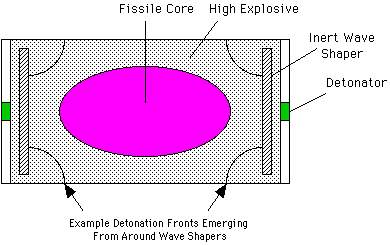
It is quite likely, that should the suitcase bombs described by Lebed actually exist, that they would use this technology. It is clear that any of the 155 mm artillery shells, if shortened by omitting the non-essential conical ogive and fuze would fit diagonally in the package that Lebed describes, and the Swift device would fit easily. If the yield is as much as 10 kilotons, then the device would have to be fusion boosted.
A somewhat more sophisticated variation would extend the linear implosion concept to cylindrical implosion, in this case an oblate (squashed) spheroid, roughly discus-shaped, of plutonium would be embedded in a cylinder of high explosive which is initiated simultaneously around its perimeter. The cylindrically converging detonation would compress and deform the fissile mass into a sphere, that could be wider than the original thickness of the system. This type of design would make the flattest possible bomb design, perhaps as little as 5 cm. The only obvious application for such a device would be briefcase bomb, and would require a special development effort to create it.
Source of weapon and test details The Swords of Armageddon, by Chuck Hansen, Chuckelea Publishing, 1995.
The Burton-Lunev Hearing
A second chapter in the Soviet suitcase bomb affair began with a Congressional hearing on
Russian espionage held by Rep. Dan Burton (R-Indiana) on 24 January 2000 in Washington, DC. Soviet ex-colonel and GRU operative Stanislav Lunev was the star witness at the sparsely attended Military Research and Development Subcommittee hearing, chaired by Rep. Curt Weldon (R-Penn.).
Featured at the hearing was a mock-up of a notional briefcase bomb. In his opening comments Weldon described this exhibit:
The model is based on unclassified data on the components in an atomic artillery shell, to see if such a system could be reassembled in a suitcase. Indeed, as it turns out, the physics package, neutron generators, batteries, arming mechanism and other essentials of a small atomic weapon can fit, just barely, in an attache case. The result is a plutonium-fueled gun-type atomic weapon having a yield of one-to-ten kilotons, the same yield range attributed by General Lebed to the Russian "nuclear suitcase" weapon.
.
Presumably Weldon's reference to it being "gun-type" refers to it being fired from a gun, not its assembly method.
 |
Mock-up of a hypothetical "suitcase" nuclear bomb, made by Congressional
staffer Peter Pry. It is basically a 105 mm artillery shell device packaged in a
large briefcase. |
The key point of the hearing was Lunev's additional allegations that nuclear suitcase bombs may have been pre-positioned in NATO countries during the Cold War, in a manner similar to the way other espionage resources including conventional explosives were known to have been cached.
Weldon summarized Lunev's claims:
Lunev defected to the United States in 1992 after working for more than
a decade in the U.S. as a GRU operative. Lunev participated in a GRU program
collecting information on the President and senior U.S. political and
military leaders so they may be targeted for assassination in the event of
war. According to Lunev, small man-portable nuclear weapons "that could be
disguised to look like a suitcase" would be employed in a decapitating Russian
attack against U.S. leaders and key communications and military facilities.
Colonel Lunev claimed that the Russian military and intelligence services
still regard the United States as the enemy and consider war with the U.S. as
"inevitable."
Colonel Lunev stated that man-portable nuclear weapons may already be
located in the United States. Lunev's claim is based on his understanding of
GRU doctrine for employing these weapons, which calls for pre-positioning
nuclear weapons in the United States during peacetime, before a crisis or war
makes penetration of the U.S. more difficult. Lunev testified that he
actively supported the GRU program to pre-position man-portable nuclear
weapons in the United States by identifying in the U.S. potential hiding
places where such weapons could be stored and concealed until needed. Lunev
was specially trained to disguise and camouflage such weapons.
One account of the hearing ran as follows:
Much of Lunev's testimony was a repeat of allegations made in his 1998
book in which he said Russia's post-Cold War leaders still see the United
States as the enemy.
Lunev, who is in the federal witness protection program, said he
masqueraded as a reporter for the Russian news agency ITAR-Tass for
three years during which he scouted "drop sites" for weapons caches in
the U.S. But he said he has no idea if they were ever planted.
Rep. Curt Weldon, R-Pa., suggested in November that the spy caches
might include suitcase-sized nuclear weapons that can produce a
10-kiloton blast.
Weldon, who also testified Monday, stood at one point, holding up a large
briefcase and announced: "I have a small atomic demolition device I'd like
to bring up to you."
Burton quickly reassured the audience that it was "a mockup" created by
the CIA.
Russian officials have confirmed their arsenal includes such devices, but
investigators have said there is no evidence they are part of the purported
hidden stockpiles.
"Ex-Spy Testifies in Hearing", Linda Deutsch, AP Special Correspondent, Tuesday, Jan. 25, 2000; 3:59 a.m. EST
This hearing has most recently reached public attention when it was recounted in the October 2, 2001 edition of the National Enquirer, page 16.
 W-54 Davy Crockett (38 K)